China bought 77,000 tons of rare earths abroad this year. Laos just froze the next mine.
Customs data out on 14 October show China imported about 1.76 tons of rare earths for every ton it exported through September. A week earlier Laos froze new rare earth approvals and set 2030 for ending raw ore exports, while Serra Verde's China contracts in Brazil run out at the end of 2026. The heavy rare earths behind the magnets in AI cooling hardware are getting harder to buy as raw ore.

The usual story about rare earths is China selling them. The customs numbers released today tell the other half: China also buys rare earths abroad, in larger volumes than it sells, and one of the countries that sells it ore is starting to say no. In August this desk wrote that Indonesia banned rare earth exports without defining how much rare earth counts (Indonesia Wrote the Rare Earth Ban and Forgot the Number). Laos has now gone further, and its ore goes to one customer.
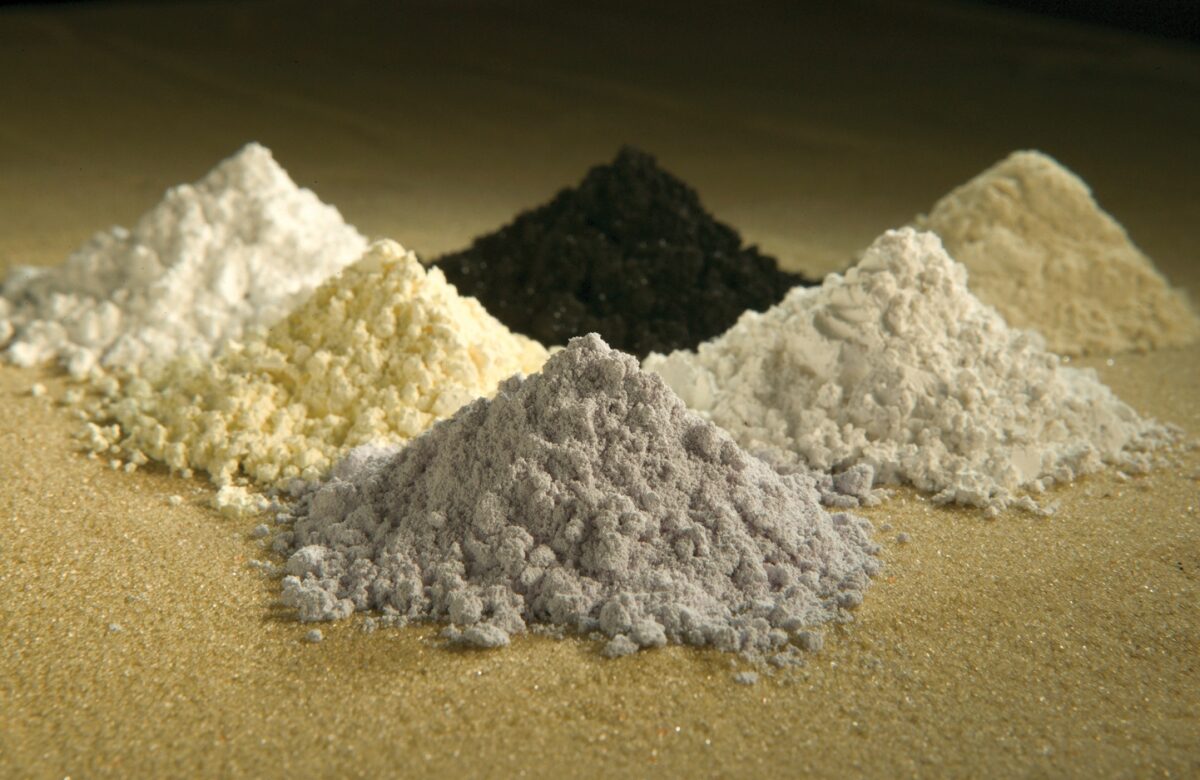
Photo: rare earth oxide powders photographed by the USDA, not material from Laos or Brazil. No free-licence photo of a Lao rare earth mine was available.
What’s happening
- China buys more than it sells. China imported 76,982.5 tons of rare earths from January to September 2026 [FX168, citing the General Administration of Customs, 14 October 2026] and exported 43,711.2 tons [Huitong Finance/fx678, citing customs, 14 October 2026]. Desk arithmetic: about 1.76 tons in for every ton out, a net intake of roughly 33,271 tons. Exports fell 9.6 percent year on year over the nine months, though September alone, at 4,269.8 tons, was up 6.7 percent on September 2025 as overseas buying improved after a summer lull [Reuters via Investing.com, 14 October 2026].
- Imports are slightly down. In the same period of 2025 China imported 78,898.4 tons and exported 48,355.7 tons [The Paper, citing Guancha and customs data, 13 October 2025]. Desk arithmetic: nine-month imports are down about 2.4 percent year on year.
- Laos freezes new rare earth projects. On 7 October Industry and Commerce Minister Malaythong Kommasith told the National Assembly the government plans to phase out raw material exports and require new natural resource projects to build processing facilities [KPL, 7 October 2026]. A Prime Minister’s directive being drafted would bar unrefined ore exports from new mines; new approvals for rare earth projects are frozen; the government has set 2030 to phase out raw exports entirely, including gypsum, barite, antimony, cobalt, tungsten and nickel; and a roadmap to curb raw shipments from existing mines is due by the end of this year [Vientiane Times via Asia News Network, 9 October 2026].
- Laos ships to one buyer. Laos exported US$104 million of rare earths in 2023, less than a tenth of Myanmar’s US$1.44 billion, and both countries’ exports went exclusively to China. 27 rare earth mines have opened across Lao river basins since 2022, 23 of them apparently in protected areas, and dysprosium and terbium are the target [Mongabay, 27 October 2025].
- Myanmar is the bigger exposure. Myanmar accounted for about 57 percent of China’s total rare earth imports in the previous year, Gracelin Baskaran of CSIS told CNBC in June 2025, and most of its heavy rare earths come from Kachin State on the Chinese border [CNBC via NBC News, 24 June 2025]. David Merriman of Project Blue pointed to ion-adsorption clay deposits in nearby Malaysia and Laos, some with Chinese involvement [same source].
Why this sits in the AI lane
Dysprosium and terbium make permanent magnets more heat resistant, and rare earth magnets sit in the cooling fans and hard drives of data centers [Kitco opinion column, Francois Moreau, 27 February 2025]. Neodymium and praseodymium magnets drive the motors and pumps in the liquid cooling that high-density AI racks increasingly need, and an industry analysis based on Sprott and S&P Global data puts China at about 94 percent of permanent magnet production [Skillings Mining Review, citing a Sprott report, updated 22 July 2026]. Laos mines exactly the heavy elements that make a magnet survive a hot rack. Every ton that Vientiane now wants processed at home is a ton that does not reach a Chinese separation plant as ore.
Brazil angle
Brazil sits on both sides of this. Serra Verde’s Pela Ema mine in Goiás signed 10-year offtake deals with Chinese companies to sell its concentrate for processing, because no other option existed while the mine was being developed; those deals were renegotiated to end at the end of 2026, and the company expects about 6,500 tons of total rare earth oxides a year by 2027, CEO Thras Moraitis told Reuters [Reuters via Kitco, 4 December 2025]. USA Rare Earth completed its purchase of Serra Verde on 4 September for US$300 million in cash plus 126.849 million new shares, about US$2.8 billion in total, and the US Department of War put US$750 million into US SIIE LLC, a vehicle that will buy Serra Verde’s mixed rare earth carbonates [Poder360, 4 September 2026]. One Brazilian feed stream into Chinese separation is therefore due to close at the end of 2026.
Brasília chose a different tool from Vientiane. Law 15.506, sanctioned on 16 September, bans nothing: it offers a CSLL tax credit of up to 20 percent of spending on beneficiation or transformation, capped at R$1 billion a year from 2030 to 2034, lets the Union put up to R$2 billion into a guarantee fund, and gives the new CIMCE council a say over international supply agreements that could affect economic or geopolitical security [Mayer Brown, 28 September 2026]. Laos uses a ban and a deadline; Brazil uses money and a council.
US angle
One US answer to Chinese processing is to own the ore before it gets there. Serra Verde is the clearest case: a mine whose concentrate went to China now belongs to a US company, and its carbonates are bound for a vehicle capitalised by the Pentagon [Poder360, 4 September 2026]. Laos offers no such opening. In 2023 its rare earth exports went only to China [Mongabay, 27 October 2025], and Chinese companies hold an estimated 30 percent of Lao land concessions [same source]. In this desk’s reading, a Lao processing mandate is more likely to move Chinese separation capacity across the border than to create a supplier the US can buy from.
China angle
For Beijing, the Lao move is a cost problem before it is a supply problem. Imports are already slightly lower than a year ago, and Laos was one of the alternatives analysts named for Kachin feed [CNBC via NBC News, 24 June 2025]. If new Lao projects must process locally, Chinese firms either build plants in Laos, under Lao rules and Lao power constraints, or lose the feed. The minister acknowledged steep logistical hurdles, and the Vientiane Times notes that the ban threatens a sudden revenue shortfall and that transport costs, fragmented supply chains and power grid limits could deter large smelter investment [Vientiane Times via Asia News Network, 9 October 2026]. Meanwhile Beijing’s own suspension of the 9 October 2025 export control package runs until 10 November 2026 [Xinhua, citing MOFCOM spokesman He Yadong, 9 April 2026].
What it means
The rare earth chokepoint is usually drawn as a single box marked China. The customs data say the box has an inlet, and the inlet runs through places like Myanmar, Laos and, until the end of 2026, one mine in Goiás. Laos has frozen new approvals and Serra Verde’s Chinese contracts end with 2026. None of this cuts China’s magnet output this quarter: existing Lao mines keep shipping until the roadmap says otherwise, and the directive is still a draft. But the direction is the same in Vientiane, Jakarta and Minaçu. Producers of ore want the processing margin, and access to cheap heavy rare earth feed for AI cooling hardware is becoming a matter of policy, not geology. This desk’s Sovereignty 50 index, which tracks AI-critical materials with concentrated single-country supply, stood at 102.4 as of 11 October [Tantalum indexes, as of 11 October 2026].
What to watch
- 10 November 2026. China’s suspension of the October 2025 export control measures ends unless extended [Xinhua, 9 April 2026]. A renewal alongside tighter feedstock would show Beijing prioritising its processing margin over volume.
- End of 2026. The Lao roadmap for existing mines is due, followed by the Minerals Law revision at the start of 2027 [Vientiane Times via Asia News Network, 9 October 2026]. The test is whether existing rare earth mines get a hard date.
- December 2026. Serra Verde’s renegotiated Chinese offtakes reach their end [Reuters via Kitco, 4 December 2025], and the CIMCE must be installed within 90 days of Law 15.506’s publication [Mayer Brown, 28 September 2026]. Watch whether the council’s first agenda covers supply agreements for Goiás concentrate.