Chile mined its smallest copper month in Cochilco's series in August. Codelco now has a second audit on the numbers it is compared against.
Chilean mine output fell 12.7 percent to 366,300 tonnes in August, while Codelco's output rose 8.9 percent. On 6 October Codelco said the same material may have been booked twice by its Ministro Hales and Salvador divisions in 2024 and 2025. Two strikes are now live or pending at Centinela and Escondida.

In June this desk wrote that Codelco’s first production audit had cracked the copper arithmetic behind the AI buildout (Codelco’s audit cracks the AI copper math). That audit was about 27,000 tonnes booked as finished copper too early. This one is different in kind. The question is no longer only how much copper Chile is producing, but how much of the 2024 and 2025 baseline that everyone measures against was ever there.
What’s happening
- August was the weakest month in the series. Chilean mine production fell 12.7 percent year on year to 366,300 tonnes in August, the lowest monthly figure in the table Cochilco has published since January 2023. January to August output was 3,248,000 tonnes, down 270,300 tonnes or 7.7 percent from 3,518,300 tonnes a year earlier. The figures are provisional [CNN Chile, citing Cochilco, 9 October 2026].
- The big private mines did the falling. Escondida produced 76,100 tonnes in August, down 27.6 percent, and Collahuasi 26,500 tonnes, down 25.1 percent. Codelco produced 101,700 tonnes, up 8.9 percent [Reuters via GBM, 9 October 2026]. Over eight months Escondida is down 11.4 percent to 797,500 tonnes, which CNN Chile calculates as about 38 percent of the national decline. Codelco’s own divisions are down 8.1 percent to 761,400 tonnes, with El Teniente off 20.3 percent [CNN Chile, 9 October 2026].
- Codelco’s second audit. On 6 October Codelco said material may have been recorded as production by more than one division, artificially inflating reported output at Ministro Hales and Salvador in both 2024 and 2025. The board hired EY for an independent audit of the nature, size and economic effect of the duplications and of their effect on variable incentive pay, sent the findings to the Ministerio Público, and kept a separate KPMG review of all divisions running [24horas, 6 October 2026]. No tonnage has been published. The earlier case covered about 27,000 tonnes, roughly 2 percent of declared production [Bloomberg Línea, 6 October 2026]. One of the two divisions now under review, Salvador, is reported up 6.0 percent in January to August [CNN Chile, 9 October 2026].
- Centinela is on strike. Two unions representing 709 workers, about 22 percent of the mine’s direct workforce, walked out on 7 October [SMM, 8 October 2026]. On 9 October three members began a hunger strike. Antofagasta has offered a 2 percent real base salary increase and a cash bonus of almost $23,000 per worker and has kept its production forecast; the unions say output could fall by about half in November if the stoppage continues [Bloomberg via MINING.COM, 9 October 2026]. Centinela produced 240,400 tonnes in 2025 [Reuters via Kitco, 30 September 2026].
- Escondida’s supervisors are next in line. BHP’s supervisors are in government mediation to avert a strike that could begin Tuesday [Bloomberg via MINING.COM, 9 October 2026]. Union president Alexis Barrera said that by the fourth day of mediation the company “no ha sido capaz de presentar una oferta nueva” (had not been able to present a new offer) [Reuters via GBM, 9 October 2026].
Why this sits in the AI materials lane
The IEA estimates that data center growth alone requires 512 kilotonnes of copper in 2030 [The Oregon Group, citing the IEA, 10 April 2025]. Desk arithmetic: Chile’s eight-month shortfall of 270,300 tonnes is already about 53 percent of that entire 2030 data center figure. That compares mine output with end demand, so it is a sense of scale, not a balance sheet. But it shows how quickly a single country’s disruption can swallow the direct copper load of the AI buildout, before counting the grid connections and transformers behind it.
The demand side has not slowed. TSMC reported September revenue of about NT$511.86 billion, up 54.6 percent from a year earlier, and January to September revenue up 41.1 percent [TSMC, 8 October 2026]. Copper settled at $14,540 a tonne on the London Metal Exchange on 9 October, up 2 percent on the week, with traders watching Centinela [Reuters via MINING.COM, 9 October 2026], after a record near $15,000 in September [Bloomberg via MINING.COM, 9 October 2026].
The baseline problem
Every year-on-year number above compares 2026 with 2025. For Codelco, the 2025 side of that comparison is now under two audits. If Ministro Hales and Salvador overstated 2025, then Codelco’s real 2026 decline is smaller than reported and its August gain is larger. Chile’s national totals would move in the same direction. That sounds like good news. It is not. It means the production trend that investors, offtakers and data center developers have been reading for two years carried an error of unknown size, at the state-owned producer [CNN Chile, 9 October 2026]. As Juan Ignacio Guzmán of GEM put it to Bloomberg, “Cometer errores de esta naturaleza dos años seguidos” (making errors of this nature two years in a row) cannot be dismissed as a simple slip [Bloomberg Línea, 6 October 2026].
Brazil angle
Brazil’s nearest offset is Vale’s Carajás copper, and it is in a maintenance trough. Salobo produced 52.4 kt in the second quarter, its best second quarter on record, and Sossego 25.9 kt. Sossego’s SAG mill was scheduled for a reform starting in August and lasting about 110 days, with the plant running on a mobile crusher in the meantime [Portal Canaã, 21 July 2026]. Desk arithmetic: the two mines together produced 78,300 tonnes in a full quarter, while Chile’s January to August shortfall averages about 101,000 tonnes per quarter. Brazil’s copper story is real, but its two largest mines combined produce less in a quarter than Chile is currently losing, and Sossego’s mill reform runs into roughly late November if it started on schedule (desk arithmetic from the 110 days).
US angle
The United States has been pulling refined copper out of the rest of the market ahead of a possible tariff. Comex inventories hit a record 675,185 tonnes on 25 August after 46 straight days of gains, and the US imported almost 885,000 tonnes of refined cathode in the first half, more than double the first half of 2024. The proposal on the table is a 15 percent tariff on refined copper from 1 January 2027, rising to 30 percent from 2028. CRU’s Robert Edwards said the tariff threat had made 2026 “at best a balanced market” [Reuters via Kitco, 25 August 2026]. A Chilean supply shortfall lands on a market where a record volume of visible metal was already sitting in American warehouses by late August.
China angle
China feels Chile first in concentrate. China imported 4.28 million tonnes of copper concentrate from Chile in the first half, down 8.3 percent and 29.3 percent of the total, against 3.74 million tonnes from Peru. Mysteel attributes Chile’s decline to falling grades, more complex ore and recovery pressure. Imports from Mongolia rose 26.9 percent and from Russia 96.3 percent, partly offsetting South America [Mysteel, 14 August 2026]. China’s concentrate supply was already shifting toward its land borders; an August that is Chile’s worst in the series pushes the same way.
What it means
Chile’s copper problem now has three parts that do not share a timetable. The ore problem (falling grades, in Mysteel’s reading) is measured in years. The labor problem (Centinela, Escondida supervisors) is measured in days and weeks. The data problem (Ministro Hales, Salvador) has no published size at all. For anyone underwriting copper supply for grid and data center projects, the third is the most uncomfortable, because it reaches backward into the history every forecast is built on.
What to watch
- Escondida supervisors. Whether the strike that could begin on Tuesday 13 October goes ahead or mediation produces a deal, and whether BHP changes its output guidance either way.
- Centinela in November. The unions’ claim of a 50 percent cut against Antofagasta’s unchanged forecast. Desk arithmetic: Centinela’s 2026 run rate is about 16,000 tonnes a month (128,400 tonnes over eight months [CNN Chile, 9 October 2026]), so a halving would be roughly 8,000 tonnes a month.
- The EY tonnage. The first number Codelco publishes for the Ministro Hales and Salvador duplications, and whether it forces a restatement of 2024 and 2025 consolidated production.
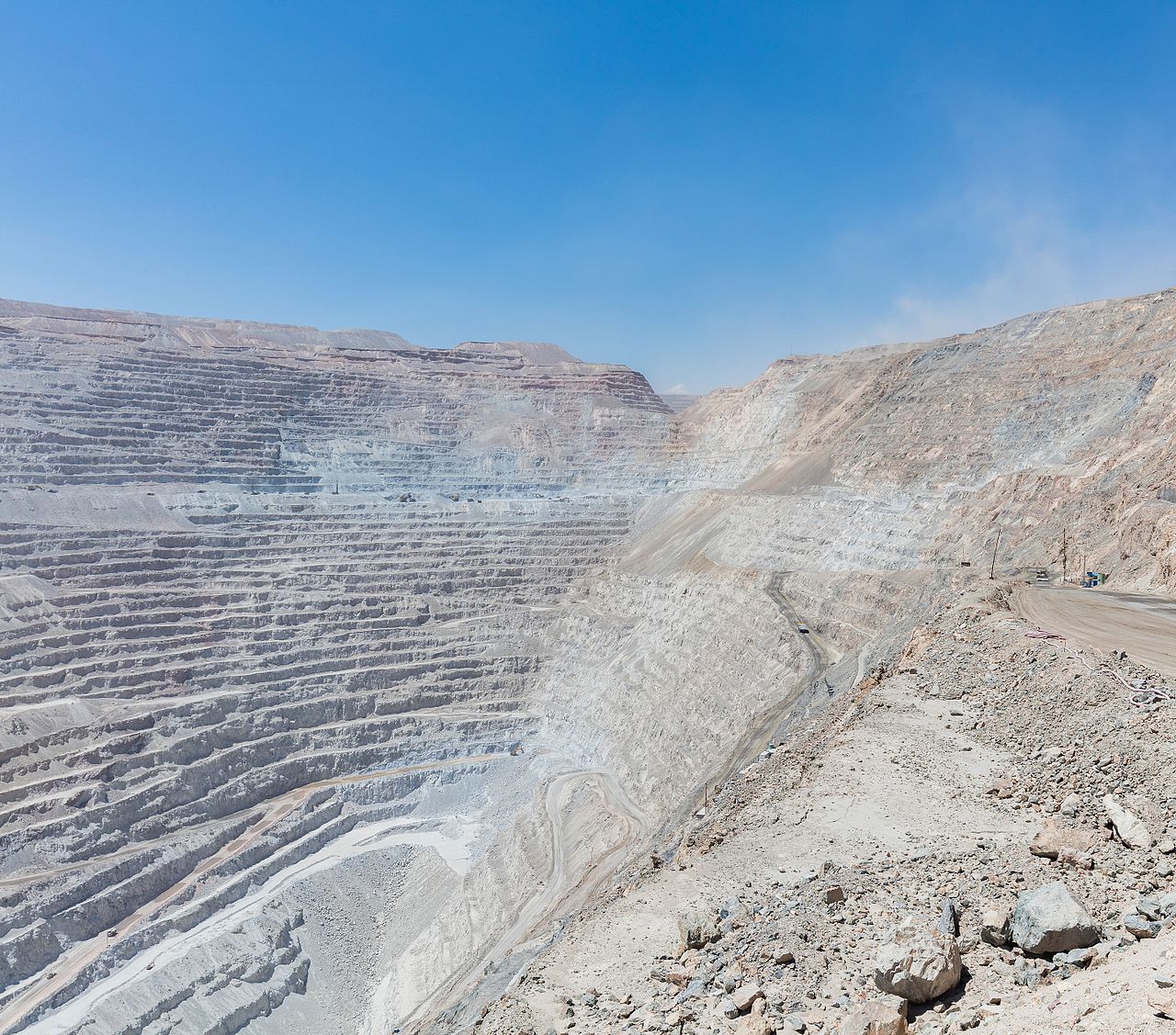
Photo: Codelco’s Chuquicamata pit near Calama in 2016, the division beside Ministro Hales. It is not one of the two divisions named in the new audit.