The copper study group now names AI as a demand driver. Its 2027 surplus still more than triples.
The International Copper Study Group sees refined copper in surplus by 104,000 tonnes this year and 368,000 tonnes in 2027, as smelters in Indonesia, India and Europe ramp up faster than consumption. The shortage the AI trade talks about is in the mine, not in the metal on the shelf.

For two years the bull case for copper has leaned on data centers. On 14 October the body that keeps the industry’s balance sheet put AI on its own list of demand drivers, and in the same statement forecast that the world will make more refined copper than it uses in both 2026 and 2027, by a widening margin. Those two facts are not in conflict. They point at where the constraint actually sits: in concentrate coming out of mines, not in cathode coming out of refineries. This desk wrote two weeks ago that China’s antitrust regulator was treating the Anglo American and Teck merger as a concentrate purchase order (China’s Copper Veto Has Nothing to Do With Competition). The ICSG numbers show why smelter owners care so much about feed.
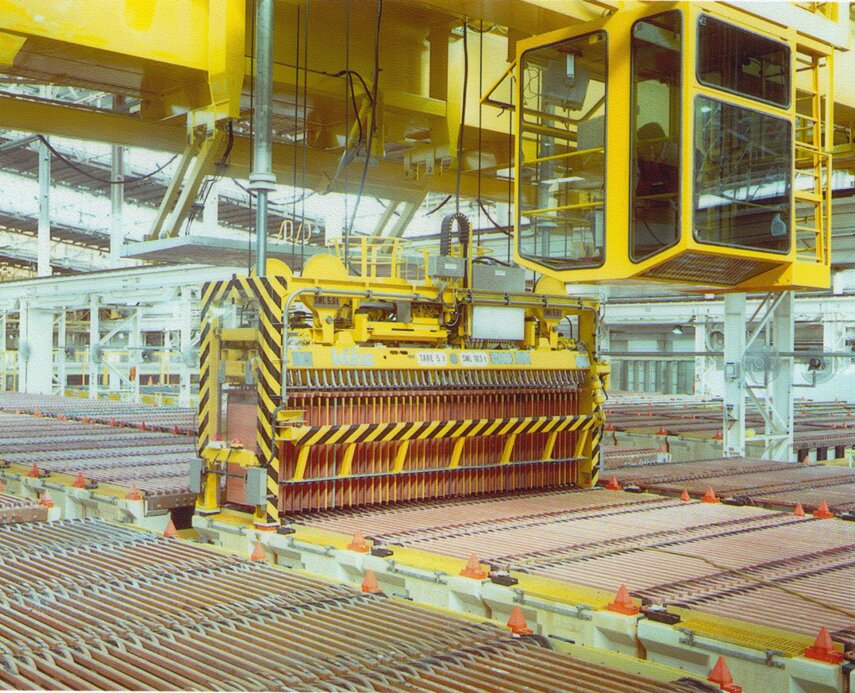
Photo: copper cathodes in a refinery tankhouse using IsaKidd technology, supplied by Xstrata Technology. It is not one of the plants named in the ICSG forecast.
What’s happening
- The surplus widens. The International Copper Study Group (ICSG) forecasts a refined copper surplus of 368,000 tonnes in 2027, up from 104,000 tonnes in 2026, after its meetings in Lisbon. The 2026 figure is slightly above the 96,000 tonnes the group projected in April [Canadian Mining Journal, 14 October 2026]. Desk arithmetic: 368,000 is about 3.5 times 104,000. The earlier forecast, which IndexBox reported with the same 96,000 tonne figure for 2026, put the 2027 surplus at 377,000 tonnes [IndexBox, 30 June 2026], so next year’s number is essentially unchanged.
- Smelters, not mines, drive it. World refined production is expected to rise just 0.4 percent in 2026 and then 3.4 percent in 2027, driven by smelter and refinery ramp-ups in Indonesia, India and the European Union, better operating rates in Chile and more output from scrap. Secondary refined output from scrap is forecast to rise about 4.7 percent in 2027 and primary refined output, including SX-EW, about 3 percent [Canadian Mining Journal, 14 October 2026].
- Mines are the weak link. Mine production growth for 2026 was cut to 1.3 percent from 1.6 percent in April, after downward revisions in Chile, China and Indonesia. Grasberg in Indonesia and Kamoa-Kakula in the Democratic Republic of Congo remain constrained after incidents in 2025, and Chilean output is declining. The group expects mine growth of 3.1 percent in 2027 [Canadian Mining Journal, 14 October 2026].
- Demand was trimmed. Refined usage is projected to grow 1.5 percent in 2026 and 2.5 percent in 2027. The 2026 outlook was lowered from April on weaker expectations for the Middle East, North America and the European Union [Canadian Mining Journal, 14 October 2026]. The earlier forecast had 1.6 percent for 2026 and 2 percent for 2027 [IndexBox, 30 June 2026], so the 2027 demand view went up and the surplus barely moved.
- AI is on the list. The ICSG names energy transition, urbanization, digitalization and investment in AI infrastructure as longer term demand drivers, and the forecast notes a divergence between expanding processing capacity and more modest consumption growth despite demand from electrification, AI and data centres [Canadian Mining Journal, 14 October 2026].
Why this sits in the AI lane
Data centers consume copper as refined metal: busbars, cable, transformers and cooling loops all start as cathode. The International Energy Agency’s Energy and AI report put data center copper demand in 2030 at 512,000 tonnes, about 2 percent of 2024 copper demand [The Oregon Group, citing the IEA, 10 April 2025]. Desk arithmetic: the ICSG’s 2027 surplus alone equals about 72 percent of what the IEA expects data centers to use in all of 2030. Those are different years and different methods, so the comparison is a sense of scale, not a forecast. It still says that, on the ICSG’s numbers, refined metal is not what will stop a hyperscaler from energizing a campus in 2027. The pinch is upstream, where smelters compete for concentrate and the mine growth number just went down.
Brazil angle
Brazil’s copper growth is mine growth, which is the scarce part of the chain. Vale Base Metals’ coarse particle flotation project at Salobo, in the Carajás region and Brazil’s largest copper operation, adds up to about 30,000 tonnes of copper a year, contained in concentrate, with start-up in the first half of 2028 [Vale Base Metals via Macau Business, August 2026]. The company projects about 700,000 tonnes a year of copper output by 2035 [same source]. Desk arithmetic: the Salobo addition is about 8 percent of the 2027 surplus, and it arrives after the ICSG’s forecast window closes. This desk covered the project when it was approved (Vale Just Added 30,000 Tonnes of Copper Without Opening a New Mine).
In a refined surplus with tight concentrate, that is the better side of the chain to sit on. A world short of feed rewards whoever owns the ore. None of the smelter and refinery ramp-ups the ICSG lists is in Brazil; they are in Indonesia, India and the EU [Canadian Mining Journal, 14 October 2026]. In this desk’s reading, Brazil sells into the bottleneck rather than owning the processing step.
US angle
North America is one of the regions where the ICSG lowered its 2026 consumption expectations [Canadian Mining Journal, 14 October 2026], even as AI infrastructure sits on its list of demand drivers. The bigger US variable is a date. The 2025 copper proclamation ordered the Commerce Secretary to update the President by 30 June 2026 on domestic copper markets, including refining capacity, so the President could decide whether a phased universal duty on refined copper of 15 percent from 1 January 2027 and 30 percent from 1 January 2028 is warranted [Federal Register, 5 August 2025]. A desk search of the Federal Register found three 2026 presidential documents adjusting metals tariffs, published on 9 April, 4 June and 23 July, and none of them mentions refined copper or cathode [Federal Register, desk search of 2026 presidential documents, 15 October 2026]. A refined duty would land on a market the ICSG expects to be in surplus.
China angle
China is the swing number. It accounts for 59 percent of global refined consumption and is expected to raise apparent usage by 2.5 percent this year, while demand in the rest of the world is largely unchanged [Canadian Mining Journal, 14 October 2026]. The ICSG warns that its Chinese apparent demand excludes changes in unreported inventories held by state agencies, producers, consumers and traders, and that such stock movements can materially alter the balance [same source]. In this desk’s reading, unreported stock changes of that kind could offset a surplus of this size without any data center being involved. The same 2025 proclamation describes a single foreign country controlling over 50 percent of global smelting capacity and four of the five largest refineries [Federal Register, 5 August 2025]. That is the smelter base now fighting for the feed the mine revisions just took away.
What it means
The copper story splits in two. Refined metal, the form that goes into data centers, looks adequately supplied through 2027 on the industry’s own forecast, with AI already named as a demand driver. Concentrate, the form that miners sell, remains the constraint, with Grasberg, Kamoa-Kakula and Chile all named as drags. That matters for where money is made. Brazilian and African mine owners hold the scarce input, Chinese, Indonesian and Indian smelters hold the capacity, and US policy is still deciding whether to tax the finished metal. This desk’s TAI index of AI materials stood at 96.8 as of 11 October, down 3.2 percent year to date [Tantalum indexes, as of 11 October 2026]. A surplus forecast that already names AI demand gives little support to a pure refined copper bet on the data center buildout.
What to watch
- 1 January 2027. The start date for the phased 15 percent refined copper duty, if the President acts on the Commerce update [Federal Register, 5 August 2025]. Desk arithmetic: about 11 weeks from today. A proclamation would reopen the gap between US and London prices on a market the ICSG sees in surplus.
- Kamoa-Kakula, Grasberg and Zambia. The 2027 mine growth of 3.1 percent depends on recoveries in Indonesia and the DRC and better output in Chile and Zambia [Canadian Mining Journal, 14 October 2026]. Any slip there turns the refined surplus back into a concentrate fight.
- The ICSG’s next forecast, in the first half of 2027. The group’s previous forecast release, listed on its homepage, is dated April 2026 [ICSG homepage, fetched 15 October 2026], so the next one is due around April 2027 if that cadence holds. If the 2027 surplus holds near 368,000 tonnes with AI already named as a driver, the data center premium in copper rests on mines, not metal.