The World Bank raised its 2027 copper forecast 18 percent. Its own chart gives AI a tenth of the demand growth.
The Bank's October outlook now sees copper averaging US$13,000 a tonne in 2027, up from US$11,000 in April, and names AI and data centers as a demand driver. The demand data behind it, from S&P Global, put AI at 1.1 million tonnes in 2025 and 2.5 million in 2040: about 4 percent of the 2025 total and roughly a tenth of the growth to 2040. The Bank's explanation of the price leans on mines and tariffs.

The World Bank published its October 2026 Commodity Markets Outlook on 28 October. For copper the headline change is in the forecast table: a 2026 average of US$13,200 a tonne and a 2027 average of US$13,000, against US$12,000 and US$11,000 in the April edition [World Bank CMO, Oct 2026, Table 1]. That lifts the 2027 call by about 18 percent (desk arithmetic).
The report also gives AI its own line. A chart titled “Drivers of future metals demand” splits demand into core economic use, the energy transition, AI and data centers, and defense [World Bank CMO, Oct 2026, Figure 4.F]. Read the numbers in that chart and the AI line is real but small, and the Bank’s own explanation of the price leans on supply and trade.
What’s happening
- The forecast. Copper prices rose 6 percent quarter on quarter in the third quarter and set new records in October. The Bank expects a 33 percent rise in the 2026 average to a record, then declines of 2 percent in 2027 and 4 percent in 2028, with prices “near record highs” [World Bank CMO, Oct 2026, p. 42]. The 2025 average was US$9,947 [same source, Table 1].
- Why it went up. The Bank’s own explanation leads with supply and trade, not data centers: mining disruptions, weather effects in Indonesia, declining ore grades in Chile, possible DRC export restrictions on concentrate, and US tariff uncertainty that pulled refined copper into US warehouses. It says global copper demand “declined slightly in the first half of 2026” and is expected to firm in 2027 and 2028 on power grids, data centers and electric vehicles [same source, p. 42].
- The AI line. Figure 4.F’s data, which the Bank sources to S&P Global’s 2026 report Copper in the Age of AI, put AI and data centers at 1.1 million tonnes in 2025, 1.8 million in 2030, 1.8 million in 2035 and 2.5 million in 2040. Core economic demand runs from 18.4 to 23.3 million tonnes and the energy transition from 8.6 to 15.6 million over the same years [World Bank CMO, Oct 2026, Figure 4.F data file]. On those figures AI is about 3.9 percent of the 2025 total and about 5.9 percent of the 2040 total, and accounts for about 10 percent of the growth between them. The energy transition accounts for about half (desk arithmetic).
- The regime call. The Bank says “the structural conditions for an entrenched regime of elevated base metal prices seem increasingly present,” citing a shift of investment toward base-metal-intensive sectors and “decade-plus timelines for exploration and mine construction” [same source, p. 41]. In its critical minerals data, the median durations of each stage from discovery to production add up to 15.5 years in emerging and developing economies and 14.3 years in advanced ones (desk arithmetic from Figure 20.D, which covers 127 mines that began production in 2002 to 2023).
- The wider tape. The Bank’s overall commodity index is forecast to rise 23 percent in 2026 and fall 7 percent in 2027; metals rise 25 percent in 2026 as aluminum, copper and tin hit records [World Bank press release, 28 Oct 2026].
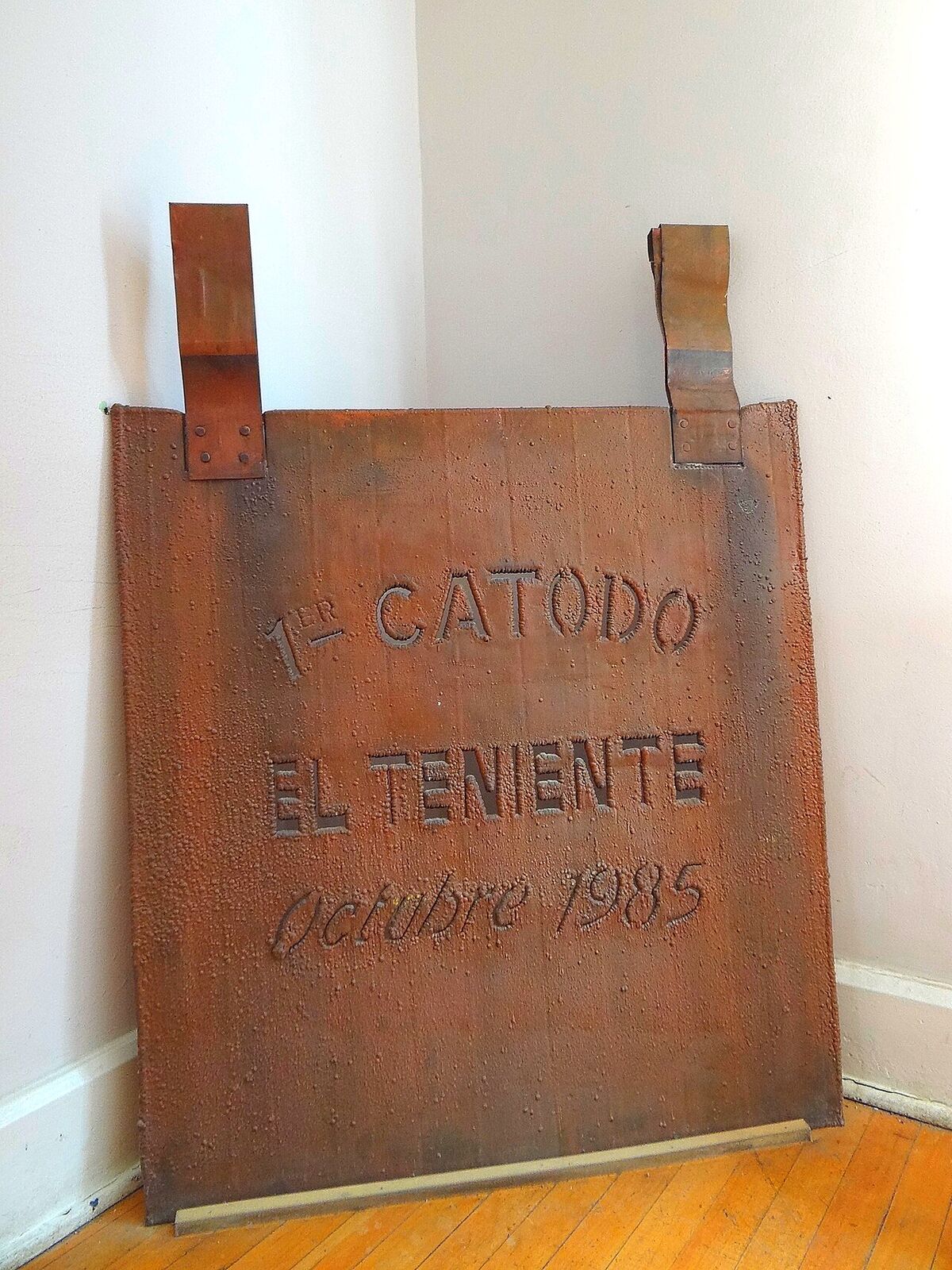
Photo: the first copper cathode produced at the El Teniente mine in 1985, displayed at the Sewell mining museum in Chile. It illustrates refined copper in general, not any shipment or site in the forecast.
Brazil angle
Vale sits on both sides of this report. Its iron ore faces a Bank forecast of a 2 percent decline in 2026 and 3 percent in each of 2027 and 2028, with output in Australia and Brazil “expected to remain ample” [World Bank CMO, Oct 2026, p. 44]. Its copper faces a record. Vale produced 98.4 thousand tonnes of copper in the second quarter, 78.3 thousand of it at Salobo and Sossego in Pará. Those two mines realized an average US$14,062 a tonne; that figure covers Salobo and Sossego only, not Vale’s copper from its Canadian nickel operations [Vale 2Q26 production and sales report, 21 Jul 2026]. That realized price is already about 8 percent above the Bank’s 2027 average forecast (desk arithmetic).
For scale only: the 0.7 million tonne rise in AI demand that the S&P data show between 2025 and 2030 is a little over twice the Pará mines’ second-quarter output run at a full-year pace (desk arithmetic). That is a comparison of size, not a claim that Brazil supplies data centers. Vale publishes its third quarter numbers inside its 3Q26 Performance Report after market close on 29 October, the first time production and financials come out together [Vale Form 6-K, 1 Oct 2026].
US angle
The US is where the 2026 price story was made. Uncertainty over possible tariffs on refined copper created a sizable COMEX premium over the LME, drew metal into US warehouses and lifted LME prices; the gap “narrowed substantially by September,” but COMEX inventories are near all-time highs and it is unclear whether tariffs take effect in January 2027 [World Bank CMO, Oct 2026, p. 42]. The 2025 proclamation on copper imports asked the Commerce Secretary for a market update by 30 June 2026 so the President could decide whether a phased refined copper duty of 15 percent from 1 January 2027 and 30 percent from 1 January 2028 is warranted [Proclamation, Federal Register, 5 Aug 2025]. Metal held in US warehouses against a possible tariff is copper not yet in any cable or busbar, whether for a data center or anything else.
China angle
China’s constraint shows up in aluminum, the other base metal the Bank ties to data centers. China produces about 60 percent of the world’s aluminum and is operating close to its official smelting ceiling of 45 million tonnes a year; the Bank expects aluminum to average a record US$3,250 a tonne in 2026, with demand supported by “data centers, electrification, transport and packaging” [World Bank CMO, Oct 2026, pp. 41 and 42]. With Chinese output near its cap, growth in aluminum supply has to come mainly from elsewhere, which the Bank expects from Gulf recovery and new capacity in Africa and Asia [same source]. Its data also count 147 restrictive trade measures on critical minerals worldwide in 2026 through September, after 228 in 2025 [same source, Figure 20.B, Global Trade Alert data].
Africa and Latin America angle
The supply side the Bank describes is Southern. Chile’s ore grades are falling, the DRC’s export restrictions “could also constrain copper concentrate trade,” and Guinea, the largest bauxite exporter, may restrict exports [World Bank CMO, Oct 2026, pp. 41 and 42].
What it means
The October outlook confirms a record copper price and puts AI on the demand chart, but it does not say AI is setting the price. The 2026 rally, in the Bank’s words, “partly reflects mining disruptions and dislocations between major refined copper markets,” the latter driven by a tariff-related stock build in the US [World Bank CMO, Oct 2026, p. 42]. The data center pull is a 2027 and 2028 support, and in the S&P data it is one driver among four, smaller than the energy transition by a factor of six in 2040. One detail matters for anyone modelling AI demand: the AI line is flat at 1.8 million tonnes between 2030 and 2035 before rising again. Those are S&P’s numbers, and other estimates differ: Fastmarkets, reporting from LME Week, put data center demand at about 1 million tonnes, and Trafigura’s Graeme Train said another one or two million could be added over the next five years [Fastmarkets, 20 Oct 2026]. A higher AI line would add to a forecast that already rests on supply. This desk’s TAI, the Tantalum AI Materials Index, stood at 87.6 in its 24 October weekly update [Tantalum indexes, 24 Oct 2026].
What to watch
- Vale’s 3Q26 Performance Report, 29 October after market close. Copper output from Salobo and Sossego, and the realized price against the Bank’s US$13,200 average for 2026.
- The US refined copper tariff decision before 1 January 2027. A decision either way changes how much metal stays in COMEX warehouses, which the Bank names as a driver of this year’s LME tightness.
- The World Bank’s April 2027 outlook. Whether the 2027 forecast holds at US$13,000 and whether the AI and data center line moves from the 1.8 million tonnes shown for 2030.
Correction, 29 October 2026: An earlier version attributed the US$14,062 a tonne realized copper price to Vale’s copper as a whole. Vale reports that figure for its copper operations only, Salobo and Sossego in Pará. The comparison with the World Bank forecast is unchanged.
Sources
Each label below matches a bracketed citation in the text. Official documents are marked primary; news and trade-press reports are secondary. Figures marked “desk arithmetic” in the text are our own calculations from these inputs.
- World Bank CMO, Oct 2026 (primary). World Bank, Commodity Markets Outlook, October 2026, CC BY 3.0 IGO: PDF. Table 1 (copper and aluminum forecasts, April 2026 comparison), printed pp. 41 to 44 (base metals text), Figures 4.F, 20.B and 20.D. Figure data from the report’s data and charts file. The Figure 4.F note credits S&P Global, Copper in the Age of AI: Challenges of Electrification (2026); the AI figures are S&P’s estimates as reproduced by the Bank.
- World Bank press release, 28 Oct 2026 (primary). “Commodity Prices Set to Increase by 23% in 2026 as Global Shocks Mount”: worldbank.org.
- Vale 2Q26 production and sales report, 21 Jul 2026 (primary). Vale S.A., “Relatório de produção e vendas da Vale no 2T26”: PDF. Copper production of 98.4 kt, Salobo 52.4 kt, Sossego 25.9 kt, realized copper price of US$14,062 a tonne for Salobo and Sossego only (footnote 1 of the price realization table: “copper operations only”; the all-operations figure including copper from nickel operations is US$14,095), confirmed in the English Form 6-K.
- Vale Form 6-K, 1 Oct 2026 (primary). “3Q26 performance report dates”: sec.gov.
- Proclamation, Federal Register, 5 Aug 2025 (primary). “Adjusting Imports of Copper Into the United States”: govinfo.gov.
- Fastmarkets, 20 Oct 2026 (secondary, reporting remarks at an industry event). “Data centre copper demand nears 1 million tonnes, tin price doubles: LME Week metals debate”: fastmarkets.com.
- Tantalum indexes, 24 Oct 2026 (this desk’s own index). See the index methodology.
Desk arithmetic, with inputs. 18 percent: US$13,000 / US$11,000 = 1.182. About 3.9 percent: 1.1 / (18.4 + 8.6 + 1.1 + 0.3 = 28.4) million tonnes. About 5.9 percent: 2.5 / (23.3 + 15.6 + 2.5 + 0.9 = 42.3). About 10 percent of growth: (2.5 minus 1.1 = 1.4) / (42.3 minus 28.4 = 13.9); energy transition (15.6 minus 8.6 = 7.0) / 13.9 = 50 percent; “a factor of six”: 15.6 / 2.5 = 6.2. Mine timelines: 12.1 + 1.4 + 2.0 = 15.5 years and 9.8 + 1.7 + 2.8 = 14.3 years. About 8 percent: US$14,062 / US$13,000 = 1.082. A little over twice: Salobo plus Sossego 78.3 kt x 4 = 313 kt; 700 kt / 313 kt = 2.2.