Canada's biggest copper mine is on strike, and the ore market it sells into was already so short that smelters were paying to process concentrate.
Workers at Teck's Highland Valley Copper went on strike on 24 October and the mine is running at reduced capacity. Its pre-strike guidance was 115,000 to 135,000 tonnes of copper this year, and Teck has not said how much output is lost. Before the walkout, on 9 October, Fastmarkets' Asian treatment charge index had already fallen to minus US$272.20 a tonne.

Members of United Steelworkers Local 7619 walked off the job at Highland Valley Copper near Logan Lake, British Columbia, on Saturday 24 October, after the union and Teck Resources failed to agree a new contract; the previous five-year agreement expired on 30 September [CFJC Today, 24 Oct 2026]. Teck said operations “are currently continuing at a reduced capacity” and that “the impact on overall production will depend on the duration of the labour action” [Teck news release, 24 Oct 2026].
It is a labour dispute at one mine. It is also the newest hit to the part of the copper chain that the AI buildout is leaning on hardest: mined concentrate, the feed that smelters cannot get enough of.
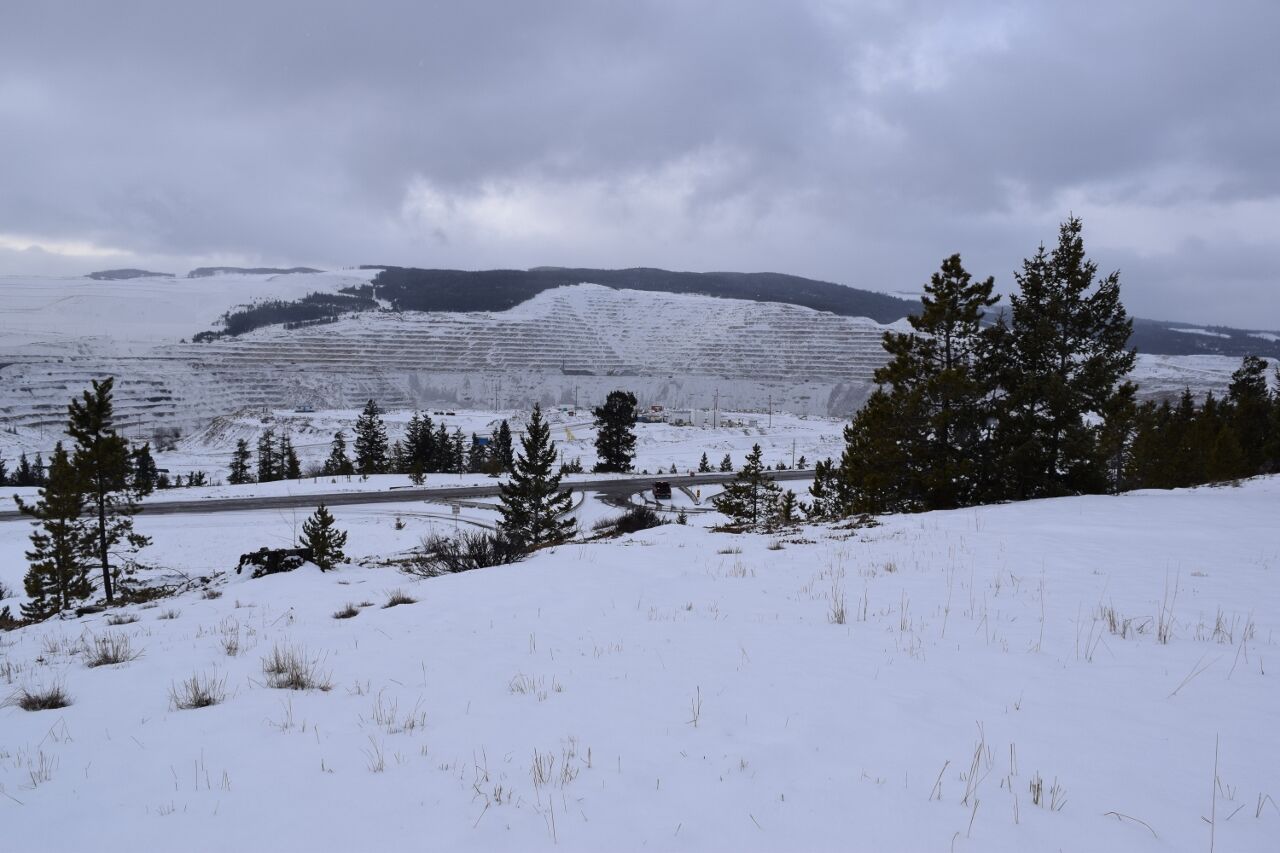
Photo: Highland Valley Copper’s open pit near Logan Lake, photographed in January 2015. It shows the mine in the story, not the strike.
What’s happening
- The walkout. Every one of the 944 members who voted backed a strike, and the union has 1,277 members. Its grievances are staffing, wages and pensions, and it says Teck struggles to keep skilled trades workers [CFJC Today, 24 Oct 2026]. Teck has not said how far output has been cut, and its molybdenum guidance of 1,500 to 1,800 tonnes was unrevised as of 26 October [SMM, 26 Oct 2026].
- The mine’s weight. Highland Valley produced 127,100 tonnes of copper in 2025 and is guided to 115,000 to 135,000 tonnes in 2026, out of 455,000 to 530,000 tonnes for all of Teck [Teck Q2 2026 results, 22 Jul 2026]. At the midpoints that is about a quarter of Teck’s copper, or roughly 340 tonnes a day on average (desk arithmetic). It produced 42,800 tonnes in the second quarter alone [same source].
- A soft quarter was already planned. Before any strike, Teck expected lower mill throughput and recoveries at Highland Valley “late in the third quarter and through the fourth quarter” as it moved to harder ore and finished mill upgrades for its mine life extension [Teck Q2 2026 results]. That project, costed at C$2.1 to 2.4 billion, is meant to carry the mine from 2028 to 2046 [Teck Q2 2026 results; CFJC Today, 24 Oct 2026]. Teck reports third quarter results before market open on 29 October [Teck release via Finviz, Oct 2026].
- The market it lands in. Fastmarkets’ copper concentrate treatment charge index for Asia fell to minus US$272.20 a tonne on 9 October, from minus US$69.70 at the start of the year, and the 2026 annual benchmark is zero [Fastmarkets, 14 Oct 2026]. That reading predates the strike. A negative charge means smelters pay miners to take their ore. SMM’s 22 October morning note had LME copper closing at US$14,370.5 a tonne [SMM, 22 Oct 2026], below the intraday record of US$14,875 on 10 September [Fastmarkets, 14 Oct 2026].
The AI link
Data center copper demand has grown “from almost nothing” to about 1 million tonnes, Trafigura’s Graeme Train told the LME Week metals debate, and “you could maybe add another million tonnes to that quite easily over the next five years, and maybe even two million” [Fastmarkets, 20 Oct 2026]. Panellists put data centers at about 3 percent of total copper demand [same source]. For scale only, Highland Valley’s 2026 guidance is equivalent to 11.5 to 13.5 percent of that 1 million tonnes (desk arithmetic); that does not mean the mine supplies that share of data center copper. Train’s other point matters more here: “Concentrates are not really growing that much” [same source]. Train said solvent extraction and scrap units have made up for limited concentrate growth [same source], so the slack sits outside the mined-ore channel. Teck itself credits copper demand “supported by investment in grid infrastructure and electricity intensive products” [Teck Q2 2026 results].
Brazil angle
Brazil’s copper has its own planned slowdown. Vale planned a 110-day rebuild of the SAG mill at its Sossego mine in Pará, due to start in August, with nine weeks scheduled in the third quarter and six in the fourth; a mobile crusher was to partly offset the impact [Vale production and sales in 2Q26, 21 Jul 2026]. Salobo and Sossego together produced 160,100 tonnes in the first half (desk arithmetic from the same report). On 30 July Vale narrowed its 2026 copper guidance to 360,000 to 380,000 tonnes, from 350,000 to 380,000, citing strong performance in the first half [Vale 2Q26 results and guidance update, 30 Jul 2026]. Vale has not yet said how much output the rebuild actually cost. From this quarter it no longer publishes a separate production report; the figures come in its 3Q26 Performance Report on 29 October, after market close [Vale 6-K, 1 Oct 2026]. If the rebuild ran to schedule, the fourth quarter has a Canadian mine on strike and a Brazilian mill under planned maintenance at the same time. Neither is a crisis alone.
US angle
Washington shapes the price this mine sells into. The July 2025 copper proclamation left refined copper untariffed and asked Commerce for an update by 30 June 2026 so the President could decide whether a phased duty “of 15 percent starting on January 1, 2027, and 30 percent starting on January 1, 2028” is warranted [Proclamation, Federal Register, signed 30 Jul 2025]. As of mid-October cathodes remained exempt, market participants were unsure whether the tariff would be extended to them, and that tariff risk had supported a COMEX premium over LME [Fastmarkets, 14 Oct 2026]. In the second quarter over half of exchange inventory sat in US warehouses, reflecting that premium, and Teck says much of it “can be viewed as unavailable to Asian consumers” [Teck Q2 2026 results].
China angle
Teck’s own future runs through Beijing. China’s market regulator, the last authority yet to clear the US$54 billion Anglo American and Teck merger, wants a commitment to a steady flow of copper concentrate to China, including volumes sold through traders [Reuters via BNN Bloomberg, 2 Oct 2026]. Chinese smelters refine up to 60 percent of the world’s cathodes and face their worst feedstock shortage in decades; the companies expect to close by March 2027 [same source]. This desk covered that demand on 2 October. The strike shows what the commitment is worth in practice: a merged group can promise tonnes, but a union local in British Columbia can still take them off the market. Anglo’s own copper output fell 5 percent in the third quarter to 174,900 tonnes, which chief executive Duncan Wanblad blamed on “record snowfall and related unplanned maintenance” in Chile, with full-year guidance held at 700,000 to 760,000 tonnes [Anglo American Q3 2026 production report, 20 Oct 2026].
Africa and Latin America angle
The supply losses are spread wide. Escondida suspended operations after a fatal accident on 23 September, two unions at Centinela struck on 7 October, Chilean mine output fell 7 percent in January to July, and Kamoa-Kakula in the DRC and Grasberg in Indonesia have not returned to full rates [Fastmarkets, 14 Oct 2026]. In Zambia, KCM restarted its Nchanga smelter on 21 September after a 106-day shutdown [same source].
What it means
Highland Valley is not big enough to move the copper balance on its own, and Teck had already planned a weaker fourth quarter there. The point is the direction. The AI buildout adds demand at the refined end, where China keeps adding smelters, while the mined end keeps losing tonnes to weather, accidents and now labour. A treatment charge index at minus US$272.20 on 9 October, before the strike began, is the price of that mismatch. In a market this short of ore, lost mine tonnes show up first in smelter terms and only later, if at all, in the cathode price that cable makers and data center builders pay. This desk’s TAI, the Tantalum AI Materials Index, stood at 87.6 in its 24 October weekly update, 12.4 percent below its 1 January base of 100 [Tantalum indexes, 24 Oct 2026].
What to watch
- Teck’s third quarter results on 29 October. Whether Teck quantifies the strike, revises Highland Valley’s 115,000 to 135,000 tonne guidance, or says the mine life extension schedule is affected.
- Vale’s 3Q26 Performance Report on 29 October, after market close. The actual effect of the Sossego SAG rebuild and whether the 360,000 to 380,000 tonne guidance holds.
- The 2027 benchmark and SAMR’s remedy. Whether miners and Chinese smelters agree any 2027 treatment charge at all after a zero benchmark for 2026, and whether SAMR’s conditions for Anglo Teck name concentrate volumes before the companies’ March 2027 closing target.
Sources
Each label below matches a bracketed citation in the text. Official documents are marked primary; news and trade-press reports are secondary. Figures marked “desk arithmetic” in the text are our own calculations from these inputs.
- Teck news release, 24 Oct 2026 (primary). Teck Resources, “Teck Provides Update on Highland Valley Copper Operations”, 24 October 2026: teck.com; filed with the SEC as Exhibit 99.1 to Form 6-K. Strike began; “operations are currently continuing at a reduced capacity”.
- Teck Q2 2026 results, 22 Jul 2026 (primary). Teck Resources, “Teck Reports Unaudited Second Quarter Results for 2026”, 22 July 2026: PDF. Highland Valley Q2 production (p. 12), outlook for lower Q4 throughput and recoveries, mine life extension capital of C$2.1 to 2.4 billion, copper market commentary, and the 2026 to 2028 production guidance table (p. 26). Dollar figures are Canadian unless stated.
- Teck release via Finviz, Oct 2026 (primary, republished). “Teck to Release Third Quarter 2026 Results on October 29, 2026”: finviz.com.
- CFJC Today, 24 Oct 2026 (secondary). “‘It’s our time to stand up’: Highland Valley Copper mine workers begin strike action”: cfjctoday.com. Strike vote (944 of 944 voting), 1,277 members, contract expiry, mine life to 2046.
- SMM, 22 Oct 2026 (secondary). Shanghai Metals Market, copper morning meeting minutes: news.metal.com. LME copper close of US$14,370.5 a tonne.
- SMM, 26 Oct 2026 (secondary). “Strike begins at Highland Valley Copper as operations fall to reduced capacity”: news.metal.com. Molybdenum guidance unrevised.
- Fastmarkets, 14 Oct 2026 (secondary, trade press). “Base metals head to LME Week 2026 with record-low TCs, war-hit supply chains”: fastmarkets.com. Treatment charge index of minus US$272.20 a tonne on 9 October (a CIF Asia Pacific index reading, before the strike), zero 2026 benchmark, LME record, mine disruptions, US tariff context.
- Fastmarkets, 20 Oct 2026 (secondary, reporting remarks at an industry event). “Data centre copper demand nears 1 million tonnes, tin price doubles: LME Week metals debate”: fastmarkets.com. Trafigura’s estimate of about 1 million tonnes of data center copper demand and the panel’s 3 percent share; these are a trader’s and panellists’ estimates, not official statistics.
- Vale production and sales in 2Q26, 21 Jul 2026 (primary). Vale S.A.: PDF. Salobo and Sossego output, the planned 110-day SAG mill rebuild and its schedule (Annex 2).
- Vale 2Q26 results and guidance update, 30 Jul 2026 (primary). Vale S.A. 2Q26 results, Form 6-K and guidance update, Form 6-K: 2026 copper guidance narrowed to 360 to 380 kt from 350 to 380 kt.
- Vale 6-K, 1 Oct 2026 (primary). Vale S.A., “3Q26 performance report dates”: sec.gov. Results on 29 October after market close; production data now inside the Performance Report.
- Proclamation, Federal Register, signed 30 Jul 2025 (primary). “Adjusting Imports of Copper Into the United States”, 90 FR, 5 August 2025: govinfo.gov. Clause on a possible phased refined copper duty of 15 percent from 2027 and 30 percent from 2028.
- Reuters via BNN Bloomberg, 2 Oct 2026 (secondary, anonymous sources). “China demands copper supply commitments for Anglo Teck merger approval, Reuters sources say”: bnnbloomberg.ca.
- Anglo American Q3 2026 production report, 20 Oct 2026 (primary): angloamerican.com. Copper output of 174,900 tonnes, down 5 percent; guidance of 700,000 to 760,000 tonnes.
- Tantalum indexes, 24 Oct 2026 (this desk’s own index). TAI value from the weekly recompute; see the index methodology for constituents, weights and limitations.
Desk arithmetic, with inputs. About a quarter of Teck’s copper: Highland Valley guidance midpoint 125 kt divided by Teck midpoint 492.5 kt = 25.4 percent. Roughly 340 tonnes a day: 125,000 t / 365 days = 342 t. 11.5 to 13.5 percent: 115 kt and 135 kt divided by Trafigura’s estimate of about 1,000 kt of data center demand; a comparison of scale, not a supply share. 160,100 tonnes: Salobo 105.2 kt plus Sossego 54.9 kt in the first half of 2026 (Vale 2Q26 report, finished production table).
Correction, 27 October 2026: An earlier version gave Vale’s 2026 copper guidance as 350,000 to 380,000 tonnes; Vale narrowed it to 360,000 to 380,000 tonnes on 30 July. It also described the Sossego mill rebuild as under way and treated the absence of a separate Vale production report as notable; the rebuild was planned, its actual effect is not yet reported, and Vale now publishes production inside its 29 October results. The headline and dek were revised to make clear that the minus US$272.20 treatment charge reading dates from 9 October, before the strike, and that the comparison with data center demand is one of scale, not supply.