Vantage booked a gigawatt of transformers built on chips. The squeeze moves from electrical steel to silicon carbide, where Chinese wafers sell for a third of the old price.
Vantage reserved more than 1 GW of Heron Power's solid-state transformers on October 21. They turn medium-voltage grid power straight into 800 VDC for AI racks. The factory starts in the second half of 2027, and the silicon carbide inside them is a market Chinese suppliers have repriced.

In July this desk argued that the AI buildout had the money but could not buy enough transformers, because every conventional unit is a copper-and-steel object made in a sold-out supply chain. This week a data center operator placed a bet on routing around that object. Vantage said on October 21 it had secured more than 1 GW of manufacturing capacity for the Heron Link, a solid-state transformer from Heron Power Electronics, to deploy across its hyperscale campuses [Vantage and Heron Power release via Business Wire, 21 Oct 2026]. The workaround does not make the materials problem disappear. It moves it, from grain-oriented steel and oil-cooled copper coils toward silicon carbide power chips, and that market has been repriced by Chinese suppliers.
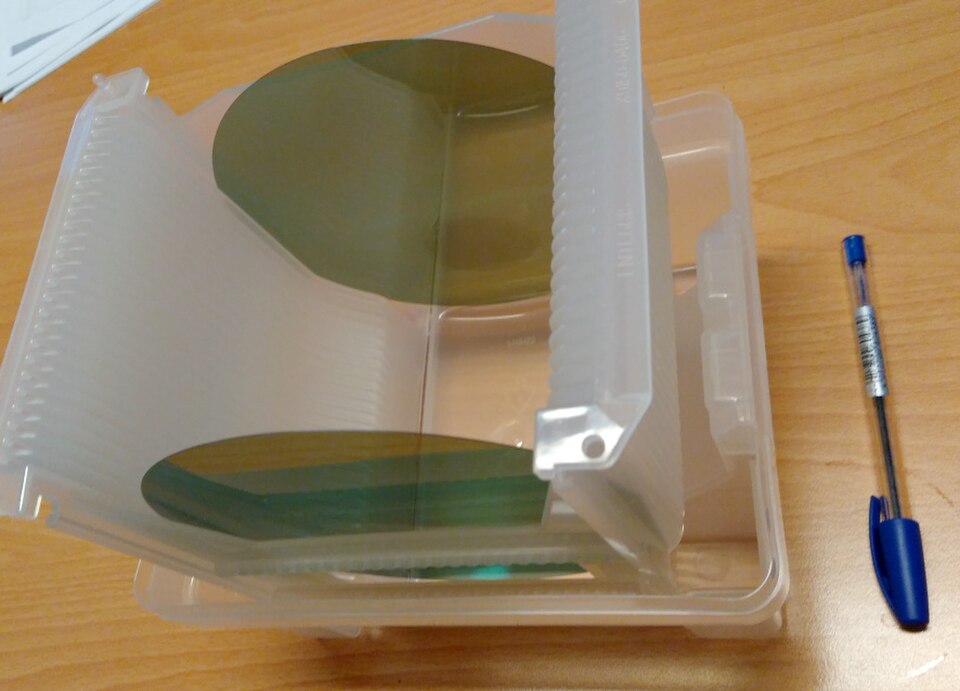
Photo: two six-inch silicon carbide wafers, the substrate class used in power chips. It shows the material, not Heron’s hardware or any Vantage site.
What’s happening
- The deal. Heron Link converts medium-voltage grid power directly to 800 VDC, with integrated energy storage, cutting the number of conversion stages between the grid and the rack. The companies target efficiency above 98.5 percent from medium voltage to 800 VDC and say the design needs less equipment, floor space, materials and labor than a conventional 480 VAC build. No quantities, deal value or delivery dates were disclosed [Business Wire, 21 Oct 2026].
- The rack it serves. The release says AI rack densities are approaching megawatt-class power and places Heron in Nvidia’s 800 VDC MGX ecosystem [Business Wire, 21 Oct 2026]. Each Heron Link handles 5 MW and contains tens of power-conversion modules, and a failed module can be swapped in about 10 minutes [TechCrunch, 18 Feb 2026]. Desk arithmetic: 1 GW at 5 MW a unit is about 200 units.
- The factory is not producing yet. Heron’s first commercial plant, in Morgan Hill, California, targets production in the second half of 2027 and a long-run capacity of 40 GW, about 10,000 units [Latitude Media, 24 Aug 2026]. TechCrunch reported pilot production in early 2027 and a ramp over the following two years [TechCrunch, 18 Feb 2026]. Desk arithmetic: Vantage’s reservation is 2.5 percent of the planned 40 GW.
- The materials swap. Heron Link uses high-frequency silicon carbide semiconductors, whose cost has fallen with the scale of the EV industry, while legacy high-voltage transformers use oil to cool copper coils [Latitude Media, 24 Aug 2026]. Neither company publishes the copper or steel content of a Heron Link, so the desk does not claim the unit is copper-free.
US angle
The US end of the silicon carbide chain is the weak end. Wolfspeed, which held 33.7 percent of the 2024 silicon carbide substrate market [TrendForce, 12 May 2025], reported fiscal fourth-quarter revenue of $149.6 million, down from $197.0 million a year earlier. Its Materials Products segment fell to $43.3 million from $78.4 million, and GAAP gross margin was negative 25 percent [Wolfspeed 8-K exhibit, 19 Aug 2026]. The same release says AI data center revenue more than doubled in fiscal 2026 and rose about 20 percent sequentially in the quarter. So AI demand is reaching the US supplier, but its cost of revenue still exceeds its revenue.
Policy is pushing in Heron’s favor. Latitude Media cites an FCC ban on new models of foreign inverters and tariffs as high as 55 percent on imported power conversion components as tailwinds for a California-built product [Latitude Media, 24 Aug 2026]. Those protect the box. They do not protect the wafer inside it.
China angle
China’s suppliers have moved from challengers to price-setters. TrendForce ranked TanKeBlue and SICC second and third in 2024 substrates at 17.3 and 17.1 percent, said SICC leads the 8-inch segment, and put global N-type substrate revenue down 9 percent to $1.04 billion on sharp price cuts [TrendForce, 12 May 2025]. Epiworld, the Xiamen-based epitaxial wafer maker backed by Huawei’s venture arm, disclosed a purchase agreement worth up to $95.8 million with an unnamed international customer on September 24, more than its trailing twelve-month revenue. The same report says the average selling price of its 8-inch wafers fell by nearly half between December 2024 and September 2025, and, citing Nikkei and Yole Group, that Chinese rivals offer six-inch material for $500 or less against about $1,500 once charged by Wolfspeed [TechTimes, 25 Sep 2026]. Desk arithmetic: $500 is a third of $1,500.
The implication is direct. A solid-state transformer built in California with Chinese-priced silicon carbide inherits a Chinese input, and one built on US wafers inherits a supplier running negative gross margins.
Brazil angle
Brazil sits on the old side of this trade, and the old side is still the binding one there. Talita Porto of Abrate, the transmission companies’ association, said a transformer takes at least two years to deliver while a data center can be built in a year and a half. The government received about 80 GW of data center connection requests; after financial guarantees were required, about 10 GW remained, with 3 GW holding signed grid-use contracts, 2 GW with approved connections and 5 GW still under ONS analysis [Brazil Journal, 11 Sep 2026].
WEG, the Santa Catarina group, is the Brazilian company closest to the shift. XP told clients after meeting WEG’s investor relations team that about 20 percent of WEG’s current US transformer orders are tied to data centers, and that new transmission and distribution capacity at Betim (MG) needs 12 to 18 months to ramp [Eu Quero Investir, 19 Aug 2026]. WEG also plans to invest US$165 million in North American generator output, starting with US$24 million for a first-phase building in Atotonilco de Tula, Mexico, due to operate from the second quarter of 2027 [Seu Dinheiro, 28 Sep 2026]. Its exposure is to conventional transformers and generators. If 800 VDC solid-state conversion spreads, part of that order book migrates to a product class built around semiconductors that Brazil does not make.
Brazil does make silicon carbide, but not the chip-grade kind. Fiven, which OpenGate Capital carved out of Saint-Gobain in 2019, runs one of its four plants in Brazil and sells silicon carbide into technical ceramics, abrasives, metallurgy, filtration and electronics; OpenGate lists high-purity silicon carbide for semiconductors as a value-creation goal, not a current product line [OpenGate Capital, Fiven case study]. The distance between industrial silicon carbide and a power-chip substrate is most of the value chain.
Vantage itself describes its footprint as North America, EMEA and Asia Pacific [Business Wire, 21 Oct 2026]. Latin America is not in the first gigawatt.
What it means
The transformer shortage was a materials story about copper and electrical steel. Solid-state conversion turns part of it into a semiconductor story, and in silicon carbide the price pressure now comes from China. For hyperscale buyers the trade is attractive: fewer conversion stages, less floor space, storage built in. For anyone tracking materials risk, it swaps a bottleneck with long lead times for one with concentrated pricing power. Neither is solved by the 2027 factory.
The deal is also a reservation, not a delivery. Heron’s CEO told Latitude Media that “to be truly bankable, we need more real runtime in the field” [Latitude Media, 24 Aug 2026]. Until that runtime exists, every gigawatt booked from Morgan Hill is a call option on a production line, and the conventional transformer queue that Abrate describes in Brazil stays the real constraint.
What to watch
- Heron’s first field runtime and pilot output, early 2027. Field tests at solar and data center sites are planned over the next year [Latitude Media, 24 Aug 2026]. Slippage past the second half of 2027 pushes Vantage’s gigawatt back into the conventional queue.
- Wolfspeed’s fiscal first-quarter 2027 report. Guidance is $140 million to $160 million in revenue with non-GAAP gross margin still negative [Wolfspeed 8-K exhibit, 19 Aug 2026]. A Materials Products line below $43.3 million would say Chinese pricing is still winning.
- Brazil’s 5 GW under ONS analysis and WEG’s Betim ramp. If connection approvals move faster than transformer deliveries, Brazilian projects will face the same choice Vantage made, with no domestic supplier on the semiconductor side [Brazil Journal, 11 Sep 2026; Eu Quero Investir, 19 Aug 2026].