Washington just struck down the grid shortcut Brazil never had. São Paulo's first access season shows why everyone wants one.
On 9 October FERC rejected most of PJM's plan to let data centers plug in early in exchange for being cut first. Israel's regulator is preparing a 200 MW ceiling per site. In São Paulo, a court record puts 451 MW of requests against 228 MW of margin in Brazil's first access season, and ANEEL's transition rule for phased data centers is open for comment until 22 November.

In September this desk set Brazil’s 26.2 GW data center connection queue against the American habit of inventing new classes of grid service so that load can arrive before the wires do. PJM’s version was a curtail-first bridge, and the point was that Brazil had nothing like it. Halfway through October, the American bridge has lost its central span, and Brazil’s own rationing system has started producing hard numbers. The question every grid with an AI queue now faces is the same: who gets the next megawatt, and on what terms.
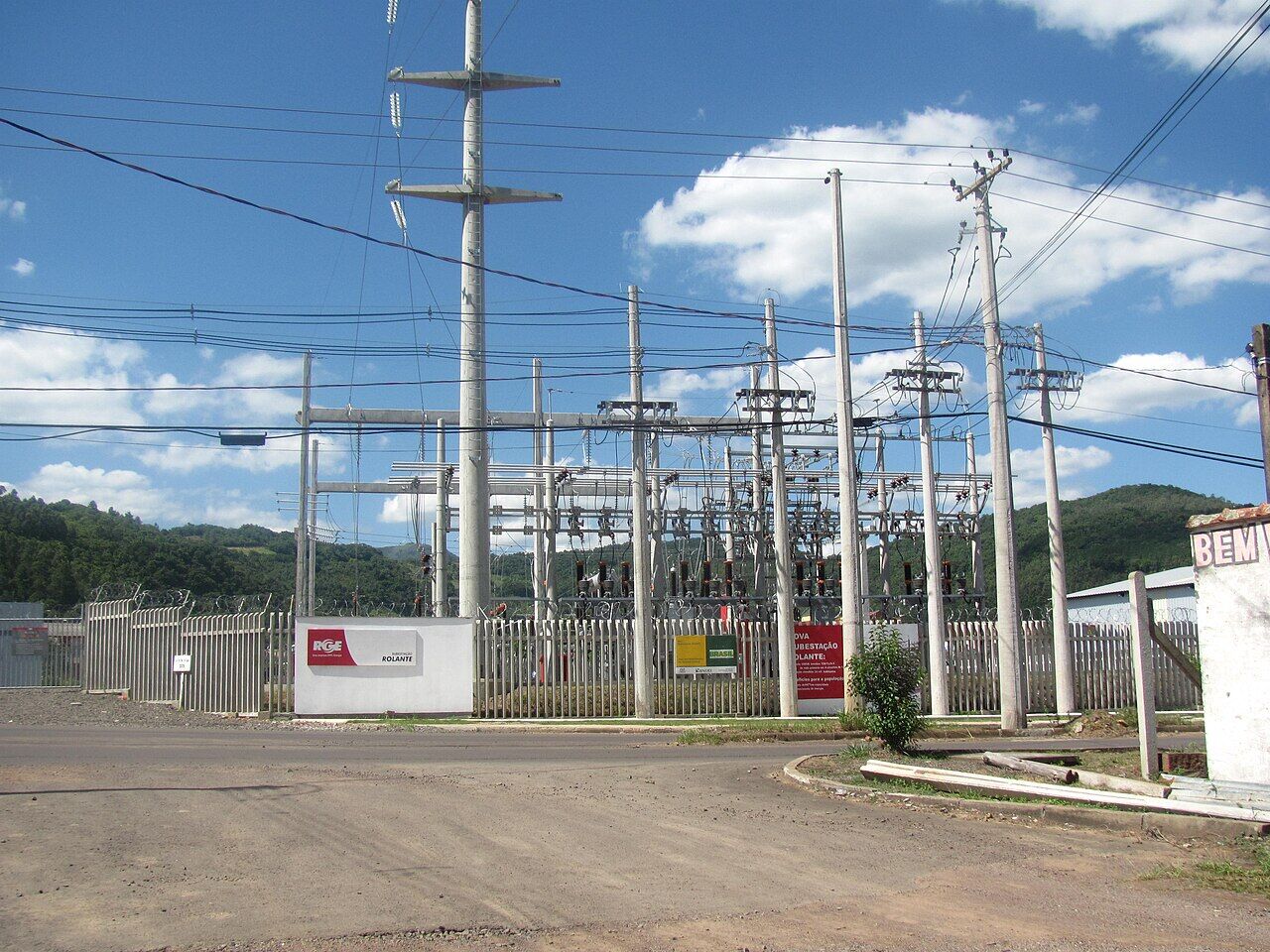
Photo: a distribution substation in Rolante, Rio Grande do Sul, in January 2013. It illustrates the asset type; it is not the Replan substation in Paulínia discussed below.
What’s happening
- On 9 October the Federal Energy Regulatory Commission rejected the core of PJM’s large load plan, the Interim Resource Adequacy Service (IRAS), which would have let large loads connect without matching new capacity if they agreed to be curtailed ahead of grid emergencies. FERC also rejected the “bring your own new capacity” rules. It approved PJM’s definition of large loads and a registry tracking each facility’s location, ramp schedule and capacity supply [Utility Dive, 12 October 2026].
- FERC’s reasons were mostly jurisdictional: provisions placed obligations on retail customers, dictated which of them get curtailed and set what amounted to a retail rate, all matters for the states. It also found the plan appeared to discriminate against large loads [Utility Dive, 12 October 2026].
- Israel’s Electricity Authority is moving to cap any single new data center at 200 MW. Connection requests total about 27,000 MW against 18,800 MW of installed generation, and requests cover 50 facilities larger than 200 MW. The draft was expected to go to a three-week public comment on Sunday [Calcalist/CTech, 14 October 2026].
- In Brazil, information in a court record reported by Cenário Energia shows 451 MW of consumer requests for 228 MW of remaining capacity in the 1st Access Season of 2026, in a dispute the outlet places in São Paulo state [Cenário Energia, 8 October 2026].
- ANEEL’s Consulta Pública nº 36/2026, which adapts transmission rules to the national access policy and sets a transition rule for data centers with phased load, takes contributions from 8 October to 22 November 2026 [Cenário Energia, 6 October 2026].
Brazil angle
The access season is the tiebreaker this desk said had not yet been tested. It has now been tested, and the numbers are blunt. Requests of 451 MW against 228 MW of margin mean roughly two megawatts asked for every one available, desk arithmetic on the court-record figures. Under the Política Nacional de Acesso ao Sistema de Transmissão, created by Decreto nº 12.772/2025, ONS assesses requests together in seasons, and where demand exceeds capacity at a point, competitive processes may be held [Cenário Energia, 6 October 2026].
The sharpest case sits at Paulínia. Pahlavan Ventures One wants to raise the contracted transmission use amount (MUST) of three data center projects from 71 MW to 157 MW each from 2029. ANEEL reported zero remaining capacity on the 440 kV bus of the Replan substation for the 2028 and 2029 products, and ONS issued negative access opinions over overload risk on the Fernão Dias to Bom Jardim 440 kV line. On 6 October a TRF-1 judge ordered ANEEL to rule on the company’s request within 48 hours of notification and froze any permanent allocation of remaining Replan capacity to third parties until it does. The court explicitly did not grant priority, reserve capacity or authorize energization [Cenário Energia, 8 October 2026].
The arithmetic of that request matters. Three projects at 157 MW would total 471 MW, up from 213 MW, desk arithmetic. The step-up of 258 MW for that single developer is larger than the 228 MW of remaining capacity in the São Paulo figures, also desk arithmetic.
ANEEL’s answer is a narrow door, not a bridge. The transition rule would let ONS prioritize 2029 load expansions for consumers that met the pre-PNAST requirements and filed by 22 January 2026, subject to technical viability, no overlap with third-party rights, and remaining capacity. It ends when the 2029 amounts are contracted or the network runs out, and it is written to block speculative capacity hoarding [Cenário Energia, 6 October 2026]. There is no curtail-first lane in it. Brazil rations by queue position and engineering, not by a promise to switch off.
The supply side is still being planned, not built. The PDE 2036, released by MME and EPE and open for comment until 6 November, projects data center demand rising from about 3 TWh to 30 TWh a year by 2036 [eixos, 8 October 2026]. ANEEL’s Transmission Auction 4/2026 on 30 October offers eight lots in seven states, São Paulo among them, with about R$ 8.9 billion in investment, 1,866 km of new lines and 12,694 MVA of transformation capacity. Cenário Energia’s account of the notice does not mention data centers [Cenário Energia, 22 September 2026].
US angle
FERC did not say curtailment is wrong. It said the states must decide who gets cut. “States have a crucial role to play in this challenge,” the commission wrote. Commissioner David Rosner’s concurring statement raised the prospect that “the region sheds thousands of megawatts of demand on an involuntary basis.” Jefferies analysts expect the idea could be “minimally revived,” likely led by states, with Ohio and Pennsylvania the ones to watch, and read the order as pointing to higher PJM capacity prices for longer, favorable to Constellation, NRG, Talen and Vistra [Utility Dive, 12 October 2026].
The market had already started routing around the grid. On 15 October AEP announced about US$4 billion for a 702 MW Bloom Energy fuel cell plant near Cheyenne, Wyoming, under a 20-year power purchase agreement with Google, with full operation targeted by the end of 2028 [ESG Today, 15 October 2026]. If the regulated shortcut is closed, the private one is to bring your own plant.
China angle
China is solving the same problem from the other end: it plans power to the cluster instead of rationing the cluster’s access. China Datang’s 500 MW solar farm at Zhongwei, Ningxia, began direct green power supply to a computing cluster in February 2026 and formal operation in early May, through four dedicated 110 kV lines. Phase one pairs it with a 1.5 GW wind farm and storage for about 8.7 billion yuan, and is expected to generate 4.3 TWh a year against 2.29 TWh of forecast consumption at the cloud base [The Next Web, 25 June 2026]. That is generation sized above the load before the load is full, desk reading of those figures.
Latin America angle
Mexico shows what happens with no rationing rule at all. Some data centers in Querétaro, which holds 72 percent of Mexico’s 279 MW of installed data center capacity, have waited up to two years to connect, according to former energy regulator Guillermo García Alcocer. CloudHQ’s US$4.8 billion six-building campus there is planned for up to 900 MW of critical IT load with its own 400 kV transmission connection [Xataka México, 9 September 2026].
What it means
Four regulators, four answers. The US regulator has pushed curtailment terms back to the states. Israel is proposing a size ceiling. Brazil is running seasons with engineering vetoes and a narrow transition lane. China builds dedicated generation and lines to the cluster.
The materials consequence is the same in each, desk analysis: when the grid cannot or will not connect a data center on its timetable, the transformers, switchgear, conductor and generation stop being shared grid assets and become dedicated, project-specific ones. CloudHQ’s 400 kV connection in Querétaro, the Wyoming fuel cells built for Google and Ningxia’s four dedicated lines are three versions of that shift. Brazil’s version is still mostly a filing and a court order.
What to watch
- 30 October, ANEEL Transmission Auction 4/2026. Whether the São Paulo lot and the 12,694 MVA of transformation capacity draw competitive bids is the nearest signal on how fast margin can be added.
- 6 and 22 November, Brazil’s two comment deadlines. PDE 2036 closes on 6 November and Consulta Pública nº 36/2026 on 22 November. Watch whether data center developers press for a curtail-first lane of the kind FERC just struck down in PJM.
- PJM’s next filing and Ohio and Pennsylvania rulemakings. PJM says it is reviewing the order; a state-led curtailment rule would rebuild the bridge under state jurisdiction. In Israel, the 200 MW draft and its three-week comment window are the parallel test.