Drax can ask to put up to 500 MW of AI servers on its biomass station. Run flat out, that load equals about three quarters of its subsidy contract's yearly volume.
Drax, Brookfield and Radiant plan a data centre of more than 1 GW at Drax Power Station, starting with up to 100 MW in 2028. Drax's 2027 to 2031 support contract covers about 6 TWh a year and lets it request up to 500 MW for a data centre, if the UK government agrees. Brazil's Redata law and China's Ningxia hub already link data centres to specific generation, in different ways.

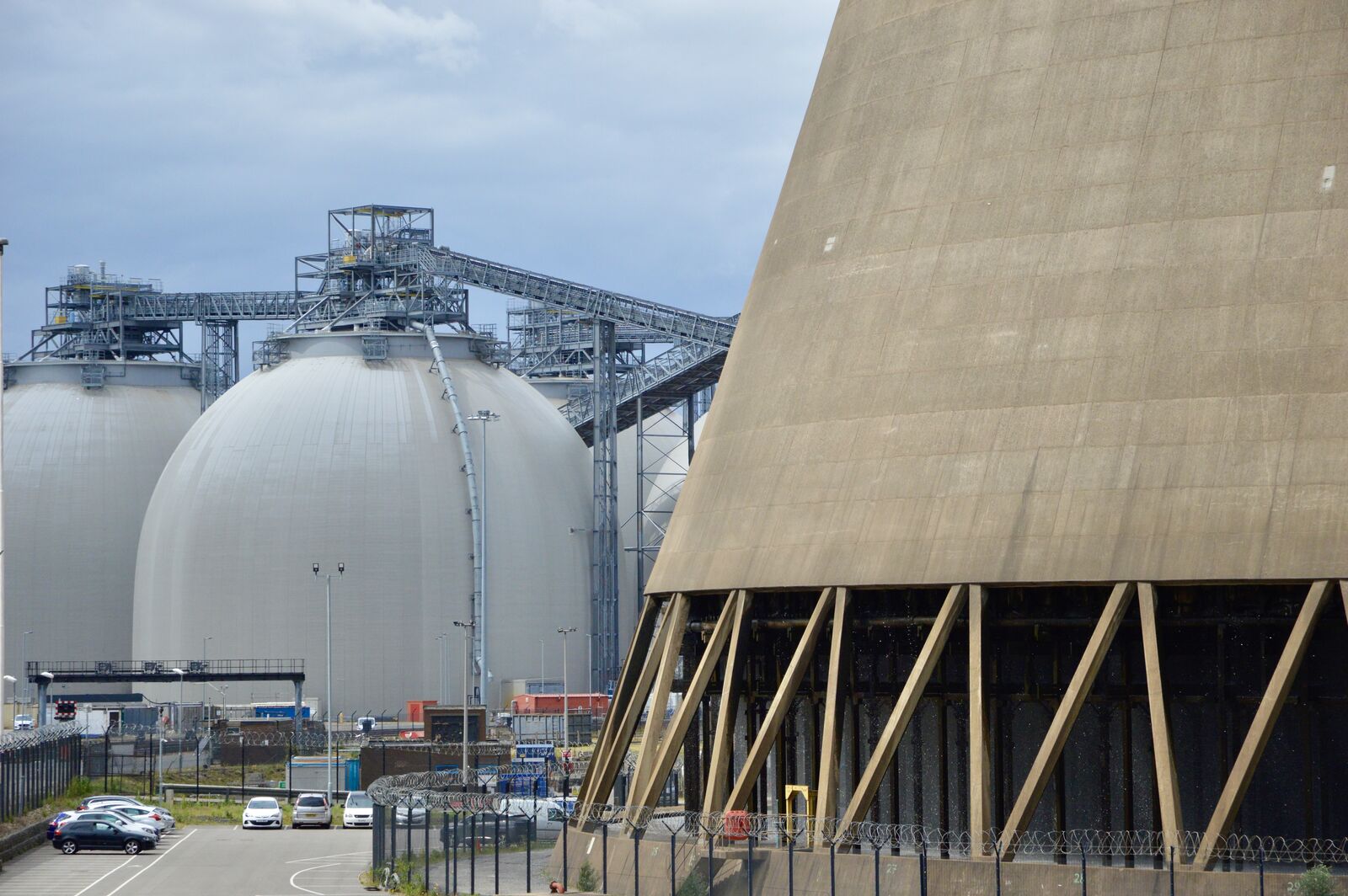
On the desk’s reading, the scarce thing in this deal is not land or chips but a grid connection that already exists, with a generator behind it. On 3 November Drax told the London market that it, Brookfield and Radiant will develop data centre capacity of more than 1 GW at Drax Power Station in North Yorkshire [Drax RNS, 3 Nov 2026]. The clause that matters sits in Drax’s subsidy contract, which already lets it ask to send part of its biomass output to a data centre.
What’s happening
- The plan. Phase 1 is up to 100 MW, with commercial operation targeted from the first quarter of 2028. Phase 2 is an “ambition” for another 500 MW between 2028 and 2031, and Phase 3 is further capacity after 2031. The site has more than 1,000 acres, about 4 GW of grid access and 2.6 GW of active dispatchable generation [Drax RNS, 3 Nov 2026].
- The money. Brookfield estimates total potential investment, including semiconductor chips, could exceed £20 billion, with an initial £2.5 billion as part of Phase 1. The capital comes through a joint venture between Brookfield and Qai, and Radiant is Brookfield’s UK AI infrastructure platform [Drax RNS, 3 Nov 2026]. TNW converts the £20 billion to US$26.8 billion and describes Qai as a subsidiary of the Qatar Investment Authority [TNW, 4 Nov 2026].
- The subsidy clause. Drax signed a Contract for Difference with the UK government in November 2025 covering about 6 TWh of biomass generation a year from April 2027 to March 2031, which Drax puts at roughly 30 percent of the baseload output of its 2.6 GW. “The CfD agreement includes a mechanism for Drax to request up to 500MW of capacity being used to power a data centre,” subject to agreement with the government and the Low Carbon Contracts Company, which will weigh value for money, energy security and sustainability [Drax RNS, 3 Nov 2026].
- How Phase 2 would be fed. Phase 2 is expected to use the station’s existing generation, supplying power round the clock through a behind-the-meter arrangement under a long-term power purchase agreement, subject to consents [Drax RNS, 3 Nov 2026]. Phase 1 will use existing infrastructure to import power directly from the grid [Drax RNS, 3 Nov 2026], and Drax is working with the grid operator to repurpose its 100 MW connection, which was built for exporting power, Bloomberg reported [TNW, 4 Nov 2026].
- What is not done. Phase 1 still needs planning, regulatory and network approvals, a suitable tenant, commercial agreements and a final investment decision by each party. No tenant is named. Radiant aims to secure anchor customer commitments before construction, and public consultation is expected to start in November 2026 [Drax RNS, 3 Nov 2026].
The arithmetic behind the headline is the desk’s, not Drax’s. A 500 MW load running every hour of a year would use about 4.4 TWh, roughly 73 percent of the 6 TWh the contract covers. Data centres do not run at full load all year, and Drax has not said how much of the supported volume a data centre would take, so this is a ceiling, not a forecast. Nor does the RNS say the data centre’s power would come out of the supported volume; that volume is only about 30 percent of the station’s baseload output, so the comparison is one of scale. The same 500 MW is about 19 percent of the station’s 2.6 GW.
Brazil angle
Brazil wrote the power source into the law. To qualify for Redata, the data centre tax regime, an operator must meet “the totality” of its electricity demand through supply contracts or self-production, from generation “from renewable or low-emission sources, in the form of regulation,” and must publish a sustainability report naming the sources it used [Lei 15.504/2026, Art. 11-B, §1, III and §10; desk translation]. The same article caps water use at a WUE of 0.05 litres per kWh [Lei 15.504/2026, Art. 11-B, §1, IV]. Which sources count as low-emission is left to regulation, so the law does not settle whether a biomass contract like Drax’s would qualify in Brazil. What it does settle is structure. A Brazilian Redata campus has to bring a named power source with it, an arrangement Drax’s contract would let it ask to offer in Britain. This desk’s 31 October piece on Crusoe and Itaipu looked at one such source on Brazil’s border.
US angle
Drax’s fuel is partly American. Drax lists pellet operations at Aliceville and Demopolis in Alabama, Morehouse and LaSalle in Louisiana, and Amite in Mississippi, and says its generation business “uses these pellets to make flexible, renewable electricity for the UK” [Drax US, Pellet Operations]. The Southern Environmental Law Center’s May 2026 table of Southeast pellet plants exporting to Europe and Asia lists five Drax plants in those states with permitted capacity of 780,000, 700,000, 700,000, 465,000 and 363,000 dry metric tons a year, about 3.0 million tons combined by desk arithmetic [SELC, May 2026]. Permitted capacity is not output, and neither source says how much of it reaches North Yorkshire. If the 500 MW request is approved, forest fibre from the US South becomes, in part, an input to compute sold in Britain. That is the desk’s reading of the structure, not a Drax statement.
China angle
China is building the same idea from new generation. Near Zhongwei in Ningxia, China Datang’s project feeds a computing cluster through four dedicated 110 kV lines that “do not pass through the public grid,” with additional demand covered through bilateral market trades. A 500 MW solar array, which began direct supply in February 2026, is the first slice of a 2 GW first phase that pairs it with a 1.5 GW wind farm and storage. Once phase one is complete, it is expected to generate 4.3 TWh a year against forecast consumption of 2.29 TWh. Authorities want renewables to supply roughly four fifths of AI data centre power by 2030 [TNW, 25 Jun 2026]. By desk arithmetic, phase one’s expected output is about 1.9 times the cluster’s forecast consumption. Drax goes the other way: it would place a load at a station that already exists and that holds a support contract due to start in April 2027.
What it means
Three systems now link the data centre to specific generation, to different degrees. China builds new solar and wind on dedicated lines and tops up from the market. Brazil makes a contracted source a condition of its tax break. In Britain, Drax’s contract lets it ask to power a data centre of up to 500 MW from a biomass station holding contracted public support. On the desk’s reading, the Drax case is the hardest test of the three, because the station’s output is due to be supported by a public contract from April 2027, and the decision on up to 500 MW falls to the government and the Low Carbon Contracts Company, not the market [Drax RNS, 3 Nov 2026]. Phase 1 is planned on existing grid infrastructure [Drax RNS, 3 Nov 2026]. The desk’s inference is that an existing connection, more than the generator, is why power stations are turning into data centre sites. Every phase beyond 100 MW is still described by the companies as an ambition.
What to watch
- November 2026. The start of public consultation, which the companies expect this month, ahead of a planning application [Drax RNS, 3 Nov 2026].
- April 2027 to March 2031. The support period during which Drax can request up to 500 MW for a data centre. Watch whether it files the request and how the government and the Low Carbon Contracts Company weigh value for money, energy security and sustainability [Drax RNS, 3 Nov 2026].
- First quarter of 2028. The Phase 1 target for commercial operation. A named anchor tenant before construction is the first sign the 100 MW is real [Drax RNS, 3 Nov 2026].
Sources
Each label matches a bracketed citation in the text. Quotes from Portuguese sources are desk translations.
- Drax RNS, 3 Nov 2026 (primary). Drax Group, RNS 5051B, “Strategic partnership for GW-scale data centre”: drax.com. Phases, investment estimate, CfD terms, 500 MW mechanism, conditions.
- Drax release, 3 Nov 2026 (primary). “Drax, Brookfield, Radiant and Qai announce £20bn partnership to deliver GW-scale data centre capacity at Drax Power Station”: drax.com.
- TNW, 4 Nov 2026 (secondary). “Drax plans a £20B AI data centre at Britain’s largest power station”: thenextweb.com. Dollar conversion, Qai ownership, and Bloomberg’s report on the 100 MW export connection.
- Lei 15.504/2026 (primary). Law of 15 September 2026 creating Redata, original text on the Chamber of Deputies site: camara.leg.br.
- Drax US, Pellet Operations (primary, updated March 2026): drax.com/us.
- SELC, May 2026 (secondary, advocacy group). “Southeast U.S. Wood Pellet Plants Exporting to Europe and Asia,” map and table: selc.org.
- TNW, 25 Jun 2026 (secondary). “China wants its green power wired straight into the data centre”: thenextweb.com.