Brazil's first critical minerals list puts copper and rare earths at the top. Gallium and germanium, under Chinese export controls since 2023, are not among the 27.
Brazil's new critical minerals council met for the first time on 5 November and sorted 27 minerals into three classes. Copper, rare earths and silicon get top priority for state financing and screening of both control changes and sales contracts. Niobium, where Brazil produces about 93 percent of the world's supply, sits in the bottom class, where sales contracts are not screened.

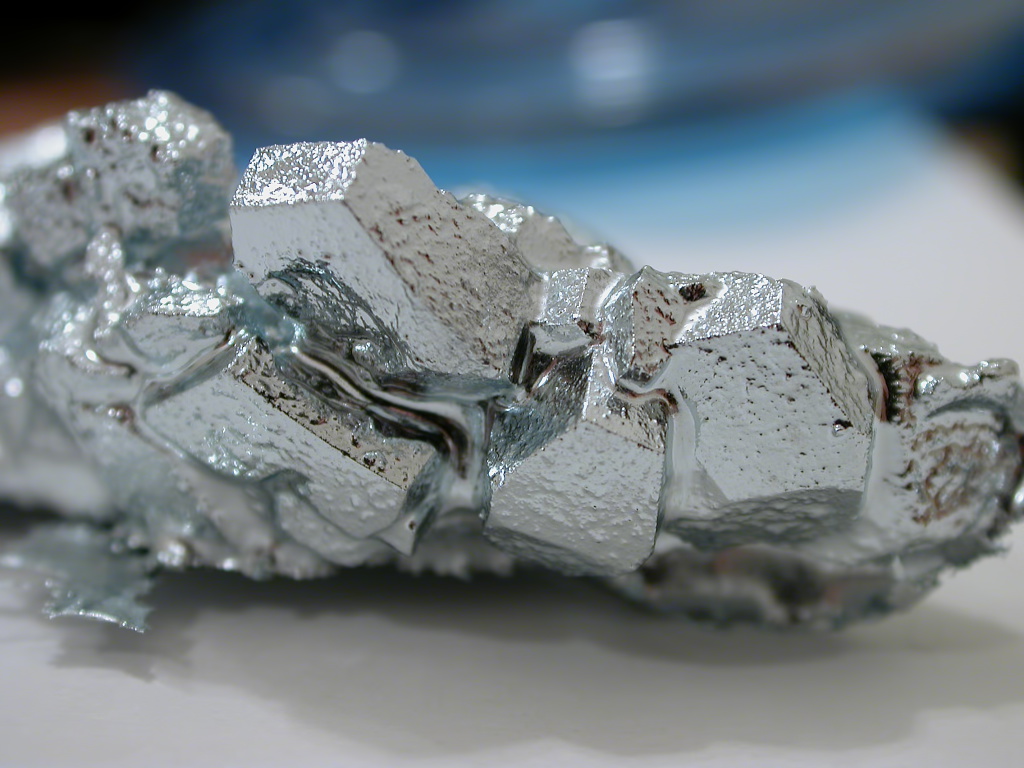
Image: crystals of 99.999 percent gallium, grown and photographed by the English Wikipedia user foobar, CC BY-SA 3.0. It shows the metal, not a Brazilian source of it. Gallium is not on the list this article describes.
On Thursday, 5 November, Brazil’s Conselho Nacional para Industrialização de Minerais Críticos e Estratégicos (CIMCE) held its first meeting, chaired by President Lula, and approved the country’s first official list of critical and strategic minerals: 27 substances in three priority classes [Secretaria-Geral da Presidência, 5 Nov 2026]. The national critical minerals policy behind it was sanctioned on 16 September [Agência Brasil, 5 Nov 2026], so the first meeting came about seven weeks later by desk arithmetic. In between, Lula was re-elected [Reuters via Investing.com, 5 Nov 2026]. This piece follows the desk’s September note on the council (Brazil’s minerals council can meet in ten days) and its pre-runoff look at the two programs (Both of Brazil’s runoff candidates promise to process rare earths).
The list matters for AI infrastructure because the class decides two things: who gets state financing first, and which deals get screened. Copper and rare earths are in the top class. Two metals that go into high-performance computing chips and data network fiber are not on the list at all.
What’s happening
- Class I, high priority (9): rare earths, graphite, lithium, nickel, cobalt, copper, manganese, silicon, uranium. These get top priority in state development instruments, and both changes of corporate control and sales contracts are screened [Secretaria-Geral, 5 Nov 2026].
- Class II, intermediate (8): tungsten, chromium, vanadium, tantalum, titanium, phosphate, potassium, sulfur. Intermediate financing priority, with the same screening of control and sales contracts [Secretaria-Geral, 5 Nov 2026].
- Class III, low (10): niobium, tin, iron, zinc, gold, magnesium, molybdenum, thorium, aluminum, the platinum group. Continuous strategic monitoring and low financing priority. Only corporate control is screened; sales contracts are not [Secretaria-Geral, 5 Nov 2026].
- Criteria. Five: geopolitical risk, concentration of world supply, substitutability, Brazil’s position in the production chain and its degree of external dependence [Secretaria-Geral, 5 Nov 2026]. Agência Brasil reports that the less developed Brazil’s chain for a mineral, the higher it ranks [Agência Brasil, 5 Nov 2026].
- Money. Only projects on listed minerals that are registered in the Cadastro Nacional de Projetos can receive support. The Fundo Garantidor da Atividade Mineral (FGAM) can receive up to R$2 billion from the Union, and the PFMCE processing programme has a fiscal limit of R$1 billion a year from 2030 to 2034 [Casa Civil, 5 Nov 2026]. Together that is R$7 billion by desk arithmetic. Agência Brasil reports that the law provides up to R$7 billion in incentives for processing and transformation projects [Agência Brasil, 5 Nov 2026]; none of the sources breaks that figure down.
The two names that are missing
The 27 names across the three classes do not include gallium or germanium. The desk checked every name in each class on the Secretaria-Geral page, which lists all 27. Casa Civil says the list can be updated at future meetings [Casa Civil, 5 Nov 2026].
Both metals sit in the AI stack. In the United States, integrated circuits took 73 percent of gallium consumption, and the US Geological Survey lists high-performance computers among their uses. China produced 99 percent of the world’s primary low-purity gallium, which is recovered mostly as a byproduct of processing bauxite [USGS, Mineral Commodity Summaries, Feb 2026]. Fiber optics are the largest US end use of germanium, consumed in making fiber optic glass “used for data networking and telecommunication,” and China is the leading producer [USGS, Feb 2026].
Brazil has the bauxite side of that chain. USGS estimates Brazil refined about 11 million tons of alumina in 2025, against 93 million in China, and Brazil supplied 71 percent of US alumina imports in 2021 to 2024 [USGS, Feb 2026]. Aluminum made the list, in Class III. Gallium, which comes out of the same refining step, did not. This desk wrote in June that Brazil’s alumina recovers no gallium (Gallium up 122 percent in twelve months). The list does not change that.
Brazil angle
The ranking rewards dependence, not dominance. Niobium is the clearest case. Brazil accounted for about 93 percent of world niobium production, and 49 percent of its ferroniobium exports went to China [USGS, Feb 2026]. Under the five criteria, a mineral Brazil already leads lands in Class III, where only control changes are screened. Copper and rare earths are in Class I, where sales contracts are screened too. That is the desk’s reading of how the criteria work out, not a reason the council gave.
Lula said Brazil does not want the state to be “o senhor supremo”, the supreme master, of exploration, transformation and industrialization, and that it wants to build partnerships [Agência Brasil, 5 Nov 2026]. The detail is still missing. Bloomberg Línea reports that the thresholds for which transactions get reviewed, and the criteria for sovereignty and market concentration risk, are pending, and that at the next meeting the council is expected to define priority industrial chains and discuss mechanisms to control mineral production, according to Casa Civil minister Miriam Belchior [Bloomberg Línea, 6 Nov 2026]. MDIC has 15 days to propose the priority production chains for the national plan [Casa Civil, 5 Nov 2026].
US angle
Washington wanted a faster door. A State Department official told Reuters that President Trump wanted preferential access to Brazil’s rare earths. Reuters reports that council members said US investment remains welcome but processing in Brazil will come first, and one member, Eracy Lafuente, said the government wants the rules presented in the first months of 2027 [Reuters via Investing.com, 5 Nov 2026]. Serra Verde, bought by USA Rare Earth in September, is Brazil’s only rare earth mine in commercial operation and does not expect full capacity until the end of next year [Reuters via Investing.com, 5 Nov 2026].
The demand side wobbled the same week. Three-month LME copper fell as much as 1.5 percent to US$13,636 a ton during trading on 6 November, its lowest since 30 July, and CRU’s Craig Lang said copper is increasingly moved by “sentiment towards data centre expansion” [Reuters via Business Recorder, 6 Nov 2026]. In Texas, governor-elect Gina Hinojosa, who takes office on 19 January 2027, has promised a moratorium on all data center approvals until the Legislature, which meets in January, passes new protections [Texas Tribune, 4 Nov 2026].
China angle
Beijing has already shown how a list works as a lever. China imposed export controls on gallium and an export licensing program on germanium in August 2023 and banned exports of both to the United States in December 2024 [USGS, Feb 2026]. Its suspension of that ban, announced on 9 November 2025, runs until 27 November 2026 [CNBC, 9 Nov 2025]. China’s reported germanium metal exports for January to September 2025 fell to 7,520 kilograms, from 18,787 in the same period of 2024 [USGS, Feb 2026].
Africa angle
Tantalum, used in electronic capacitors [USGS, Feb 2026], is in Class II, so its sales contracts will be screened. Brazil mined an estimated 190 tons of tantalum in 2025, behind Congo (Kinshasa) at 1,300, Rwanda at 400 and Nigeria at 390, out of about 2,500 worldwide [USGS, Feb 2026]. By desk arithmetic Brazil’s share is about 8 percent, and the three African producers ahead of it account for about 84 percent.
What it means
Brazil now has a ranked list that tells state lenders where to go first and tells buyers which contracts will be read. On AI inputs it is mixed. Copper, rare earths and silicon are at the top. Tantalum is in the middle. Niobium, Brazil’s strongest card, is near the bottom, which in the desk’s reading follows from the criteria rather than from neglect. Gallium and germanium, two metals China has already restricted, are not on it.
The list can be updated at future meetings, Casa Civil says. The thresholds, the priority chains and the screening rules come later. Casa Civil says being on the list is what unlocks the new instruments, including the FGAM guarantee fund; the PFMCE’s fiscal limit starts in 2030 [Casa Civil, 5 Nov 2026].
What to watch
- MDIC’s priority chains, due within 15 days of 5 November (about 20 November by desk arithmetic). Whether the proposal names data center hardware, magnets or chips as a target chain, and whether gallium recovery from alumina appears anywhere in it.
- 27 November 2026. The end date in China’s suspension of its US ban on gallium and germanium exports, as announced in November 2025, and whether Beijing extends it.
- Early 2027. The rules council member Eracy Lafuente told Reuters the government wants presented in the first months of 2027, and whether their transaction thresholds would catch acquisitions like USA Rare Earth’s purchase of Serra Verde.
Sources
- Secretaria-Geral da Presidência da República, “Conselho Nacional aprova lista de 27 minerais críticos e estratégicos,” 5 November 2026: https://www.gov.br/secretariageral/pt-br/noticias/2026/novembro/conselho-nacional-aprova-lista-de-27-minerais-criticos-e-estrategicos
- Casa Civil, “Governo Federal aprova lista brasileira de minerais críticos e estratégicos,” 5 November 2026: https://www.gov.br/casacivil/pt-br/assuntos/noticias/2026/novembro/governo-federal-aprova-lista-brasileira-de-minerais-criticos-e-estrategicos
- Agência Brasil, “Governo define minerais críticos prioritários para investimentos,” 5 November 2026: https://agenciabrasil.ebc.com.br/economia/noticia/2026-11/governo-define-minerais-criticos-prioritarios-para-investimentos
- Bloomberg Línea, “Governo põe terras raras e cobre no topo da lista de minerais estratégicos para o país,” 6 November 2026: https://www.bloomberglinea.com.br/brasil/governo-poe-terras-raras-e-cobre-no-topo-da-lista-de-minerais-estrategicos-para-o-pais/
- Reuters via Investing.com Brasil, “ANÁLISE: Vitória eleitoral de Lula frustra esperanças dos EUA de acesso rápido às terras raras do Brasil,” 5 November 2026: https://br.investing.com/news/economy-news/analisevitoria-eleitoral-de-lula-frustra-esperancas-dos-eua-deacesso-rapido-as-terras-raras-do-brasil-2117998
- Reuters via Business Recorder, “Copper falls, heads for worst week since March on AI rout,” 6 November 2026: https://www.brecorder.com/news/40447768/copper-falls-heads-for-worst-week-since-march-on-ai-rout
- The Texas Tribune, “Gina Hinojosa won the governor’s race. What happens to Texas data centers now?,” 4 November 2026: https://www.texastribune.org/2026/11/04/data-center-texas-pause-gina-hinojosa-governor-policies/
- CNBC, “China suspends ban on exports of gallium, germanium, antimony to US,” 9 November 2025: https://www.cnbc.com/2025/11/09/china-suspends-ban-on-exports-of-gallium-germanium-antimony-to-us.html
- US Geological Survey, Mineral Commodity Summaries 2026: gallium https://pubs.usgs.gov/periodicals/mcs2026/mcs2026-gallium.pdf ; germanium https://pubs.usgs.gov/periodicals/mcs2026/mcs2026-germanium.pdf ; bauxite and alumina https://pubs.usgs.gov/periodicals/mcs2026/mcs2026-bauxite-alumina.pdf ; niobium https://pubs.usgs.gov/periodicals/mcs2026/mcs2026-niobium.pdf ; tantalum https://pubs.usgs.gov/periodicals/mcs2026/mcs2026-tantalum.pdf