Brazil Rewrote Its Export Law So That Compute Counts as a Shipment
A Medida Provisória at the end of 2025 let a data center qualify for export processing zone benefits. The first tenant at Pecém is Chinese, draws 300 MW, and is legally forbidden from serving Brazilian users.

The most consequential piece of AI infrastructure policy in Latin America is not a subsidy or a mineral pact. It is a definitional edit. Brazil changed what the word export means, and a 34 hectare site on the Ceará coast is the result.
What is happening
- Fábio Feijó, president of ZPE Ceará, says federal export processing zone law had to be amended by Medida Provisória at the end of 2025 before the Pecém data center could proceed. His reasoning is worth quoting because it is the whole story: “a data center does not export anything, it is the building that rents its space to someone, so that is not export, it is internal service provision. Whoever exports is the data center’s client.” He credits Governor Elmano, Minister Camilo and President Lula with the fix [Trends CE via ABRAZPE, 23 March 2026].
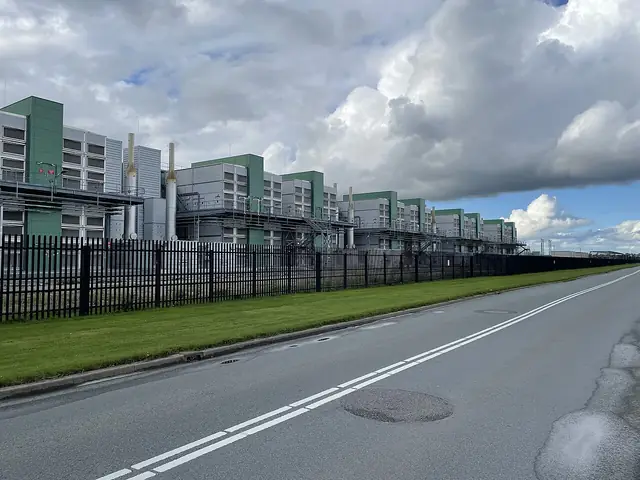
- The facility sits inside the ZPE of the Pecém Industrial and Port Complex, on 34 hectares near the CE-348 highway between Caucaia and São Gonçalo do Amarante. It is built exclusively for the export of services, processing data belonging to users resident outside Brazil [Poder360, 19 May 2026].
- Phase one is 200 MW of IT capacity against roughly 300 MW of energy demand, which Poder360 describes as enough to supply 2.2 million people. Ground was broken on 6 January 2026, operations are targeted for the third quarter of 2027, and the ramp runs to 2029 [Poder360, 19 May 2026].
- Omnia, the data center company controlled by Pátria Investimentos, signed a 20 year, US$2 billion power agreement with Casa dos Ventos. It is structured as autoprodução, meaning Omnia takes an equity position in the generation parks and thereby wins exemption from grid charges and better tariff treatment. Most supply comes from the 630 MW Ibiapaba wind complex in Ceará, still under construction, with a smaller share from Dom Inocêncio in Piauí. Poder360 reports the contract will sustain a wind and solar expansion plan under which Casa dos Ventos estimates adding 2.1 GW to its installed capacity [Poder360, 19 May 2026].
- The National ZPE Council attached a condition that deserves more attention than it has received: the power must be 100 percent clean and newly built. The stated purpose is to ensure the campus does not compete for electricity already serving the local population or push tariffs up [Poder360, 19 May 2026].
The Brazil angle
Brazil has spent two years being told it is a mineral supplier waiting for someone to buy. Pecém is the other ledger. The announced investment figure is R$200 billion over ten years, against a Ceará state GDP of R$232.2 billion in 2023 [Diário do Nordeste citing IBGE, 10 July 2026]. That is roughly 86 percent of annual state output, which is desk arithmetic on those two published numbers and should be read as a scale marker rather than a forecast.
The autoprodução structure and the new-generation condition together are a more sophisticated instrument than most of what Washington and Brussels have produced. The tenant does not get to draw down existing Brazilian supply. It has to fund new wind, and it pays for the privilege by taking equity risk in the parks. Whether Ceará captures enough of the value is a separate question. The National ZPE Council estimates 550 direct and indirect jobs in operation and 3,800 during construction [Poder360, 19 May 2026]. For an asset of this size, that is a thin operating footprint, which is the standard trade for hyperscale.
The materials loop is straightforward. Roughly 300 MW of continuous load, backed by a 2.1 GW generation expansion, is a copper, magnet and transformer order. It is worth being precise that 300 MW of demand against a 630 MW nameplate wind complex is not a one to one match, because wind runs at a capacity factor well below unity. That gap is part of why the contract reaches into Piauí at all.
The US angle
On 24 August, Metal Tech News published its account of FORGE, the Forum on Resource Geostrategic Engagement, unveiled at the 2026 Critical Minerals Ministerial, a February convening of 54 nations and the European Union in Washington. The framework is built on five objectives including a preferential trade zone and, in USTR Jamieson Greer’s words, exploring “how trade measures, such as border-adjusted price floors, can strengthen our domestic critical minerals industries.” The article names roughly two dozen partner countries, from Argentina and Peru to Guinea and Uzbekistan. Brazil appears in none of the FORGE rosters it lists [Metal Tech News, 24 August 2026].
Note the date carefully. The ministerial was February. The publication is last week. The gap matters because it means the roster has had six months to add Brazil and has not.
The China angle
The tenant is ByteDance. Bloomberg reported on 1 July that the Pecém campus would be the company’s largest data center facility outside China, at 200 MW rising toward almost 1 GW, across 20 halls [Bloomberg via w.media, 2 July 2026]. Chinese operators are moving compute offshore to get around domestic energy bottlenecks and US restrictions on AI hardware exports, and Brazil offers cheap new wind, a federal tax exemption on IT capital expenditure announced by Lula in September 2025, and 89 percent low carbon electricity in 2025 [w.media, 2 July 2026].
CADE cleared Omnia’s purchase of the Casa dos Ventos stake, taking it to 100 percent of the project company, in despatches dated 8 December 2025 [Convergência Digital, 10 December 2025]. That is a 2025 event, not a recent one, and should not be read as fresh news.
Africa and LATAM
Pecém was chosen for the cable landings. Feijó counts 18 subsea cables on a 5 km stretch of Praia do Futuro in Fortaleza, 16 of them live, and ranks that concentration behind Tokyo and Singapore [Trends CE via ABRAZPE, 23 March 2026]. Omnia’s stated logic is proximity to those landings, which give some of the shortest routes from Brazil toward Europe and Africa [Poder360, 19 May 2026]. A campus that legally cannot serve Brazilian users needs exactly that.
What it means
The desk has spent the year tracking whether the Global South can move up the AI value chain from digging to refining. Pecém is a third option nobody was modelling: sell the electrons as a service. Ceará is not exporting wind, it is exporting the output of wind, wrapped in silicon, through a customs regime that had to be rewritten because it was built for physical shipments. The Tantalum AI Materials Index sat at 108.8 on 22 August, up 8.8 percent year to date, with the materials sub-index at 109. Neither captures this, because the thing being exported is not a material.
The uncomfortable part is that the rule change was made for a specific tenant, and that tenant is Chinese. Brazil built a good mechanism, and the first company through the door was the one Washington spends most of its minerals diplomacy trying to route around.
What to watch
- The Tecto confirmation. Diário do Nordeste reported on 10 July, citing an anonymous source, that Tecto Data Centers plans a second Pecém hyperscale campus at R$350 billion, with construction between late 2026 and early 2027. Tecto has not confirmed and ZPE Ceará declined to comment, citing confidentiality. Treat the figure as unverified until the company says it.
- The other five. The same report says five more hyperscale campuses are planned for the ZPE, three with pre-contracts signed. Watch for the first of those pre-contracts to convert into a signed ZPE authorisation, which is the point at which Pecém stops being one deal and becomes a cluster.
- The water and licensing fight. Socio-environmental associations have challenged the project over water use and impacts on Indigenous communities near the port, with the site about 2 km from Lagoa do Cauípe. Omnia says the closed loop cooling system will consume at most 30,000 litres a day, of which about 10 percent goes to cooling, and that it holds preliminary, installation and operating licences from Semace [Poder360, 19 May 2026]. Watch whether Semace’s licences survive challenge, because the ZPE model only scales if the environmental precedent holds.