Google's Wyoming fuel cells run on a metal the world makes 80 tons of a year
AEP will spend about US$4 billion on 702 MW of Bloom fuel cells to power a Google campus near Cheyenne. Bloom's cells use a scandium-doped electrolyte, drawn from a byproduct market the USGS sizes at about 80 tons of oxide a year, led by China. Bloom says supply is secure. Its own annual report does not name the metal.

The AI power debate usually runs through turbines, transmission and reactors. On 14 October American Electric Power added a fourth route with a price tag: about US$4 billion for 702 megawatts of Bloom Energy fuel cells near Cheyenne, Wyoming, sold to Google under a 20-year contract [AEP, 14 October 2026]. AEP sells the technology as fast to deploy, and it makes power without burning the gas [AEP, 14 October 2026]. It does not escape the periodic table. Bloom’s solid oxide cells use a zirconia electrolyte doped with scandium oxide [Bloom Energy, 7 July 2026], and the US Geological Survey puts world scandium oxide production at about 80 tons in 2025, with China the leading producer [USGS Mineral Commodity Summaries, February 2026]. This desk flagged scandium in Goiás drill holes last month (A Goiás drill hole returned rare earths, niobium and tantalum). Wyoming is where that metal meets a hyperscaler’s load.
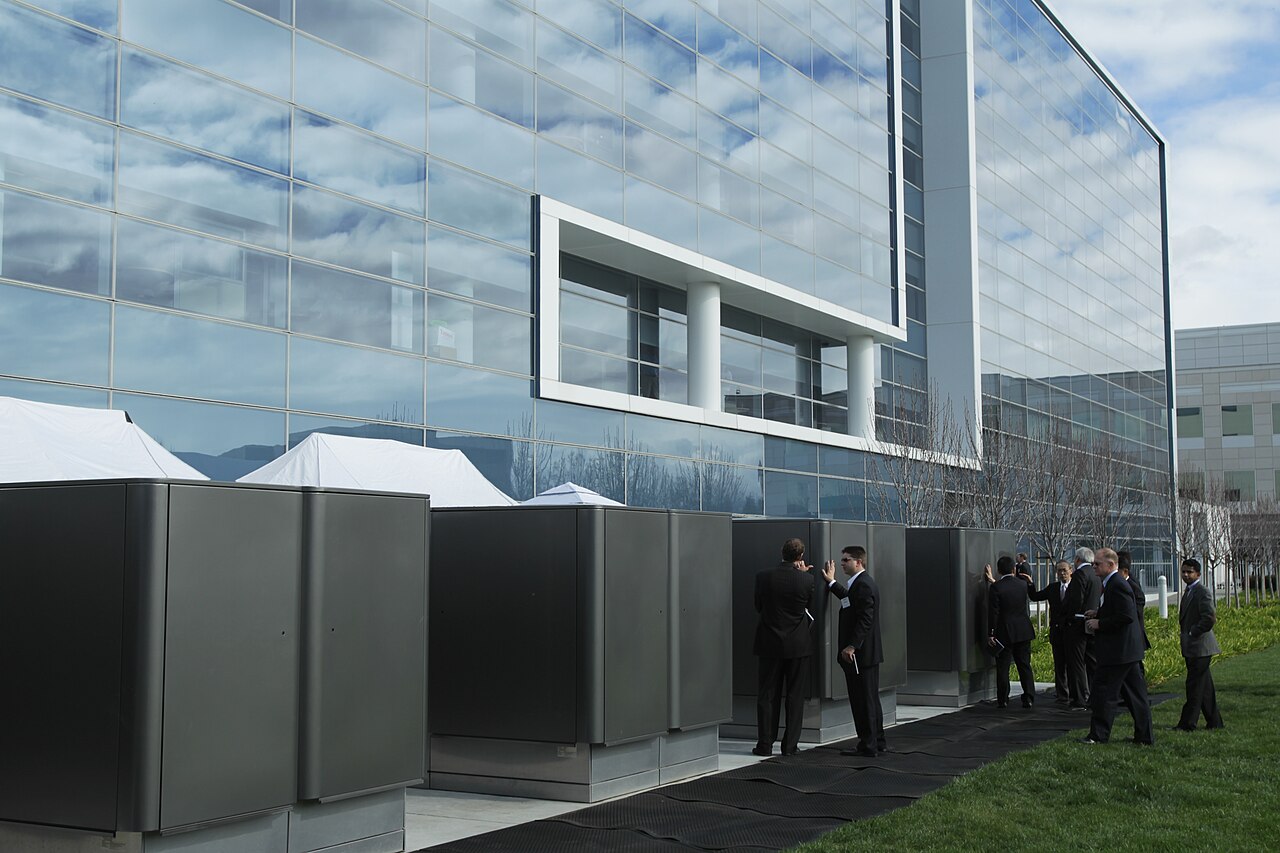
Photo: Bloom Energy Servers at eBay’s headquarters in San Jose, California, at the company’s launch in February 2010. It is not the Cheyenne plant, which has not been built.
What’s happening
- The deal. AEP plans to invest about US$4 billion in the 702 MW project. Google will buy the power from Cheyenne Fuel Cell, LLC, which AEP owns about 92 percent of, with funds advised by Basalt Infrastructure Partners holding nearly 8 percent. Construction is planned to begin in 2026, with full operation by the end of 2028, and the plan includes carbon capture [AEP, 14 October 2026]. Desk arithmetic: about US$5.7 million per megawatt.
- It fills most of an old order. Bloom and AEP signed a supply agreement for up to 1 GW of solid oxide fuel cells in November 2024 [Power Engineering, November 2024]. Desk arithmetic: Cheyenne alone uses about 70 percent of that ceiling. In January 2026 an AEP subsidiary signed an unconditional agreement to buy “a substantial portion” of that 1 GW option for about US$2.65 billion, plus a 20-year offtake with an unnamed “high investment grade” customer for a plant near Cheyenne. The offtake stayed subject to conditions whose deadline was extended in June; if they are not met in December 2026, AEP is owed additional consideration [AEP 10-Q, second quarter 2026]. The October release names Google but does not say the conditions are met [MGRID, 16 October 2026].
- The campus is bigger than the plant. Black Hills Corp. will build 564 MW of new gas generation at its Cheyenne Prairie Generating Station for about US$1.8 billion between 2027 and 2029, and manage about 2.1 GW of third-party turbine and fuel cell resources in a private microgrid, for a total mix of about 2.7 GW. Google covers the cost of serving the data center [Power Engineering, 9 October 2026]. Desk arithmetic: 702 MW is about 26 percent of 2.7 GW, though neither company has confirmed the AEP plant sits inside the microgrid [MGRID, 16 October 2026].
- The factory has room, on paper. Bloom is doubling its Fremont, California plant from about 1 GW to 2 GW of annual capacity by the end of 2026, and says the site can reach about 5 GW [Bloom Energy 10-K for 2025]. Desk arithmetic: Cheyenne equals about 35 percent of a full year at 2 GW.
- The metal is small and byproduct-bound. Scandium is produced only as a byproduct, mainly from nickel and titanium streams and old tailings. Global oxide capacity was over 90 tons a year in 2025, production about 80 tons and consumption about 60 tons, with solid oxide fuel cells among the main uses [USGS, February 2026].
Why this sits in the AI lane
The mechanism is direct. Google’s Cheyenne campus will be served largely through a private microgrid of turbines and fuel cells [Power Engineering, 9 October 2026], and Bloom’s version of that generation is a ceramic stack whose electrolyte uses scandium. Bloom’s chief operating officer likens the dopant to “a sprinkle of salt” per cell, says it lets a stack use fewer layers for the same output, and says scandium oxide remains “the best choice for our current fuel cell platform” even though alternatives exist [Bloom Energy, 7 July 2026]. Bloom does not publish grams per megawatt, so this desk cannot size Cheyenne’s scandium draw. It can say that an 80 ton market has a buyer whose orders come in gigawatts.
The price data cut against a panic reading. Scandium oxide averaged US$890 to 1,000 a kilogram in 2021 and about US$640 in 2025 [USGS, February 2026]. Desk arithmetic: 28 to 36 percent lower. Supply is not short today. The risk is concentration, not volume.
Brazil angle
Brazil is not on the map yet. The USGS lists identified scandium resources in Australia, Canada, China, Finland, Guinea, Kazakhstan, Madagascar, Norway, the Philippines, Russia, South Africa, Ukraine and the United States, and Brazil is not among them [USGS, February 2026]. The nearest Brazilian lead is Rare Earths Americas’ Homer project in the Goiás alkaline province, where scandium “returns notable grades in weathered zones” and still needs dedicated metallurgical work; the first resource estimate is targeted for 2027 [Geomechanics.io, 24 September 2026, first reported by MINING.COM]. Bloom says it recovers scandium as a byproduct of titanium, nickel, cobalt and uranium processing [Bloom Energy, 7 July 2026]. Whether any Brazilian circuit in those metals could carry a scandium step is a question this desk has not seen tested in public.
The power model is the other contrast. Brazil’s data center pipeline is plugging into the grid, not building beside it: 68 connection requests across 37 municipalities through December 2025, 65 percent of them from renewable energy companies [Mongabay, 24 August 2026]. Brazil’s problem is surplus clean power it cannot always dispatch, with curtailment costing generators R$3.2 billion in the first half of 2025 [same source]. A Wyoming-style fuel cell park is built for a grid that cannot deliver in time. On these numbers, Brazil’s binding constraint looks closer to the opposite.
US angle
The United States did not mine or recover scandium commercially in 2025 and relies on imports for 100 percent of consumption. Shipping records put 2021 to 2024 oxide imports at 89 percent from Japan, refined from Philippine feed, and 11 percent from China [USGS, February 2026]. Washington is moving: the Defense Logistics Agency plans to buy more than 6,000 kilograms of scandium oxide for the stockpile from Sorel-Tracy, Quebec, over five years, and the Defense Department awarded US$10 million and US$29.9 million to two domestic scandium efforts in 2025 [same source].
Bloom’s annual report is more cautious than its blog. It says fuel cell production “requires rare earth elements,” that Bloom relies on “a limited number of suppliers” and in some cases “sole suppliers” for materials “in limited supply,” and that it does not expect China’s rare earth availability to affect its 2026 production forecast [Bloom Energy 10-K for 2025]. Scandium is not named. The blog says Bloom sources scandium oxide “from multiple sources and suppliers across multiple countries” and that its chain can support up to 25 GW a year [Bloom Energy, 7 July 2026]. Both can be true. Only the blog gives the scandium detail, and it names no suppliers or volumes.
China angle
China leads world scandium production, and in April 2025 it added specific export controls on scandium metal, alloys, oxides and compounds. As of December 2025 those controls remained in effect, though Beijing had begun issuing general export licences to selected exporters [USGS, February 2026]. Bloom says it is not dependent on China for scandium oxide [Bloom Energy, 7 July 2026]. In an 80 ton market, the licence regime of the leading producer is leverage at the margin.
What it means
Fuel cells turn part of AI’s grid problem into a materials problem. For Google that is a good trade while the material stays cheap and the quantities small, and it holds only if non-Chinese byproduct supply grows with Bloom’s factory. Canada’s expansion at Sorel-Tracy targets 9 tons a year [USGS, February 2026]. Desk arithmetic: about 11 percent of 2025 world production. In this desk’s reading, the opening for Brazil, Guinea, Madagascar and South Africa is a byproduct circuit bolted onto mines and plants that already exist, not a scandium mine.
What to watch
- AEP’s December 2026 deadline. Whether AEP confirms the revised conditions on the Cheyenne offtake are satisfied, now that Google is named as the buyer [AEP 10-Q, second quarter 2026].
- Bloom’s 2 GW line by year end. Completion at Fremont on schedule tests the 25 GW scandium claim at its first real scale [Bloom Energy 10-K for 2025].
- China’s scandium licences. Any narrowing of general licences, or new scandium-specific rules, in the USGS 2027 summary or MOFCOM notices. A shift there would show first in the ex-works China oxide price, last at US$640 a kilogram [USGS, February 2026].