Aalo authorized, HALEU clock runs out, Beijing's hotline opens
DOE cleared Aalo-X on June 25, putting the third Reactor Pilot Program reactor inside Trump's July 4 deadline. Centrus's Phase III HALEU production contract closes today. MOFCOM's whistleblower channel for mineral exports goes live July 1.
Three deadlines converge between today and Saturday. Energy Secretary Chris Wright told an Idaho audience on June 25 that he had authorized Aalo Atomics to proceed with its 10 MWe Aalo-X experimental reactor, putting a third Reactor Pilot Program participant on track for criticality by July 4 [American Nuclear Society, June 29 2026]. Centrus Energy’s Phase III HALEU production contract with the Department of Energy expires today, June 30 [ANS Nuclear Newswire, June 25 2025]. China’s Ministry of Commerce Announcement No. 26, published June 24, formalizes a whistleblower channel for critical mineral export violations that goes live July 1 [MOFCOM, June 24 2026]. None of the three are independent. They are the front, middle, and back end of the same fuel-and-fission stack the AI buildout has tied its power story to.
What’s happening
- Antares Nuclear’s Mark-0 became the first private advanced reactor to achieve zero-power fueled criticality under the DOE program on June 4 at Idaho National Laboratory [DOE, June 4 2026]. Valar Atomics’ Ward 250 followed at the Utah San Rafael Energy Lab on June 18, becoming the first DOE-authorized reactor sited outside a national lab [DOE, June 18 2026]. Aalo’s sodium-cooled Aalo-X is the third candidate, with DOE Secretary Wright telling an Idaho audience on June 25 that the company had been authorized to proceed [American Nuclear Society, June 29 2026].
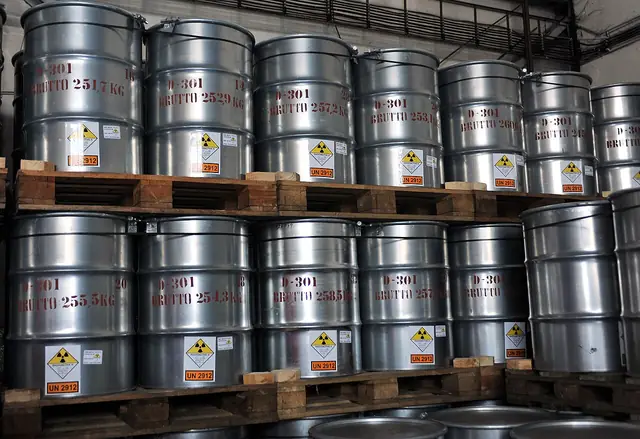
- Centrus Energy’s Piketon, Ohio centrifuge cascade is the sole domestic source of high-assay low-enriched uranium (HALEU). Phase II of the DOE production contract required 900 kg by June 30, 2025 (Centrus delivered over 920 kg). Phase III, extended one year by DOE on June 20, 2025, ends today. DOE retained two further extension options of up to eight additional years [ANS Nuclear Newswire, June 25 2025; Centrus 8-K].
- DOE’s HALEU Allocation Process, finalized September 2024, set a target of making 21 metric tons of HALEU available by June 30, 2026 to seed near-term demand from the Reactor Pilot Program, Oklo, X-energy, and TerraPower [Centrus / EnkiAI summary].
- China’s MOFCOM Announcement No. 26, published June 24, takes effect July 1. Individuals and firms can report unauthorized exports of strategic minerals and dual-use items through an online portal at aqygzj.mofcom.gov.cn and a reporting hotline at +86-10-12369 during posted hours. Real-name reports may receive rewards. The announcement formalizes enforcement infrastructure on top of the April 2025 medium and heavy rare earth licensing regime and the October 2025 broader controls, which are scheduled to snap back from suspension on November 10, 2026 [MOFCOM, June 24 2026; Mining Technology, May 2026].
Brazil angle
Brazil is the only Latin American country with operating uranium enrichment capacity. Indústrias Nucleares do Brasil (INB) completed Phase 1 of the Resende centrifuge plant at the end of 2022, meeting roughly 70 percent of Angra 1’s fuel demand [Rio Times]. Amazul holds the engineering contract for the Phase 2 expansion, designed to add enough separative work capacity (SWU per year) to cover all three Brazilian PWRs and end the country’s import dependence on enriched UF6 [World Nuclear News]. None of that capacity is HALEU. The technology base, the licensing path, and the customer set were all built around the 4.95 percent low-enriched uranium that conventional pressurized water reactors run on. The reactor designs going critical through Idaho and Utah this month run on TRISO fuel enriched to between five and twenty percent. Brazil has no fast path into that supply chain. The critical minerals partnership announced June 22 by BNDES, Vale, and Petrobras does not yet reference HALEU [Mining.com, June 22 2026].
US angle
The reactor pilot is the proof-of-concept layer. The fuel chain is what scales it. The Carnegie Endowment paper Tantalum covered on June 7 counted roughly 13 gigawatts of nameplate hyperscaler nuclear commitments across restarts, small modular reactor PPAs, and direct partnerships. That gigawatt math sits on top of an enrichment base that, as of today, is one operating American cascade and a DOE allocation measured in tens of tonnes. Centrus’s $900 million DOE task order announced in January 2026 to expand the American Centrifuge Plant in Piketon is the capital answer. The next contract option (the two-year Phase IV plus extensions) is the schedule answer. Hyperscaler PPAs already on the board cover the restart side: Microsoft and Constellation at Three Mile Island Unit 1 (835 MW, targeted 2027), Meta and Constellation at the Clinton plant in Illinois (1,121 MW), Amazon and Talen at Susquehanna (1,920 MW), Google and Kairos for a 500 MW SMR fleet [Trellis, Introl summaries]. The SMR and microreactor commitments hyperscalers have made beyond restarts (Meta’s January 9, 2026 RFP awards funding at least two TerraPower Natrium 345 MW units plus offtake rights on six more, and a separate Meta and Oklo agreement; Amazon’s $500 million X-energy investment plus offtake on the Cascade Xe-100 project owned and operated by Energy Northwest in Washington) all assume HALEU fuel availability that does not yet exist at the scale the schedules require [PowerMag, January 2026; X-energy press release; PowerMag, Cascade unveiling].
China angle
The MOFCOM whistleblower channel is calibrated, not theatrical. It targets enforcement leakage on the existing rare earth, tungsten, antimony, gallium, germanium, and graphite controls without stacking new entity restrictions on top of the June 22 additions (MP Materials, USA Rare Earth, and eight other US firms placed on the export control list per Al Jazeera and stocktitan coverage). The announcement’s plain text obliges service providers (freight forwarders, customs declarants, e-commerce platforms, financial intermediaries) to report suspected violations they encounter in the course of business. Beijing’s pattern through 2025 and 2026 has been to layer enforcement tools (license review, entity lists, audit triggers, whistleblower channels) onto the same underlying material set rather than to ratchet the list of controlled items. The signal to overseas processors is that the cost of buying licensed Chinese-origin intermediates carries a compliance tail that did not exist at the start of the year.
What it means
The AI buildout has two scaling laws to satisfy. The compute scaling law is well understood and well financed. The power scaling law has a fuel chain underneath it that today is a single American centrifuge cascade, a DOE inventory measured in tens of tonnes, and a Brazilian enrichment base that does not produce the right product. The Reactor Pilot Program is closing the reactor side of the gap on a political deadline. The fuel side has no equivalent forcing function in any country outside China.
What to watch
- July 4: whether Aalo-X reaches criticality, and whether Radiant Industries (Kaleidos, moving into the NRIC DOME test bed per INL Director John Wagner on June 25) or Deployable Energy (selected for the Nuclear Energy Launch Pad in April) get close enough to claim a fourth.
- July 1 onward: whether MOFCOM publishes any enforcement actions from the new whistleblower channel within the first quarter, particularly any naming of overseas processors handling Chinese-origin REE intermediates without license.
- November 10, 2026: scheduled snap-back of the October 2025 broader China critical mineral suspensions. The whistleblower channel is the enforcement architecture; November is the policy test.