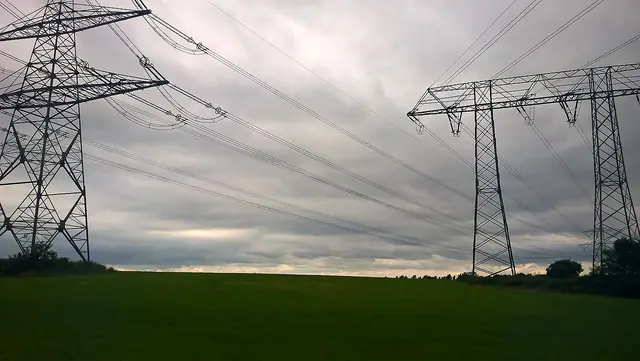
Washington found 23 gigawatts inside power lines that already exist. The order is aluminum, not copper.
DOE selected 31 SPARK projects on September 24: $1.9 billion federal against $3.35 billion of cost share, more than 1,500 miles of line rebuilt and nearly 21,000 miles instrumented. PPL's Pennsylvania award names the conductors. Brazil's planner listed the same instrument as an option and has costed conventional new build instead.

On Thursday, September 24, the Department of Energy’s Office of Electricity announced its intention to help fund 31 grid-improvement projects across 26 states under a programme called Speed to Power through Accelerated Reconductoring and other Key Advanced Transmission Technology Upgrades, or SPARK [US Department of Energy, 24 September 2026]. The projects carry $5.25 billion in total, $1.9 billion federal and $3.35 billion in recipient cost share. Recipients are expected to reconductor or rebuild more than 1,500 miles of transmission line and deploy grid-enhancing technologies across nearly 21,000 miles. DOE says the result is more than 23 gigawatts of additional electricity capacity.
DOE’s framing leans on consumer bills. Read the bill of materials instead. Washington has put $1.9 billion behind 23 gigawatts that requires no new right-of-way, and that choice has a physical consequence. The consequence is not copper.
What’s happening
- 31 projects, 26 states, $5.25 billion total, $1.9 billion of it federal, funded through the Grid Resilience and Innovation Partnerships programme [DOE, 24 September 2026].
- More than 1,500 miles reconductored or rebuilt, grid-enhancing technologies across nearly 21,000 miles. Desk arithmetic: about 2,414 km and about 33,800 km respectively, and roughly fourteen miles instrumented for every mile physically rebuilt.
- DOE’s own release is internally inconsistent on the headline number. The body says more than 23 gigawatts. Office of Electricity Assistant Secretary Catherine Jereza, quoted in the same release, says more than 20 [DOE, 24 September 2026]. The desk uses 23 because that is the figure DOE states in its own voice, and flags the gap.
- Named recipients include PPL Electric, Duke Energy Carolinas, Eversource Energy, Alabama Power and Kit Carson Electric Cooperative [TD World, 25 September 2026]. Alabama Power’s Northeast Alabama Smart Grid Deployment was selected for $50 million and is framed around regional data center growth; Entergy Mississippi’s is a three-state deployment across Arkansas, Louisiana and Mississippi aimed at data center and industrial load [DataCenterDynamics, 25 September 2026].
- These are selections, not signed awards. PPL states it will spend the coming months negotiating and finalising terms with DOE [PPL Electric Utilities, 24 September 2026]. Nothing has been procured yet.
The physical order
PPL’s award is the one that names the hardware, and that makes it the useful document. The company was selected for up to $71.5 million for the Montour Grid Resilience and Advanced Reconductoring Project, rebuilding approximately 29.3 miles of an existing 230-kilovolt corridor in Pennsylvania. It will use a combination of Aluminum Conductor Steel Supported (ACSS) and Aluminum Conductor Composite Core (ACCC) conductors on targeted segments, plus dual optical ground wire carrying a Distributed Acoustic Sensing demonstration [PPL Electric Utilities, 24 September 2026].
Unpack those acronyms and the procurement becomes legible. ACSS, developed in the 1970s, pairs a higher-strength steel core with annealed aluminum outer strands. ACCC-type advanced conductors replace the steel core with pultruded carbon fiber-reinforced polymer, which carries roughly twice the tensile strength of conventional steel at about 75 percent less density and a coefficient of thermal expansion around ten times lower. That last property is the point: less sag at high temperature means more conductive aluminum in the same diameter, lifting line capacity without heavier towers. CTC Global’s design wraps the carbon core in a glass fiber sheath against galvanic corrosion, and the core carries no current itself [CompositesWorld, 24 June 2026].
So the SPARK bill of materials is aluminum by mass, steel and carbon fiber composite by structure, epoxy resin by process, and optical fiber by instrumentation. It is conspicuously not a copper order and not a new-tower order. When the United States clears load by squeezing existing corridors rather than cutting new ones, the demand impulse routes into light metal and composites, and the copper intensity of a gigawatt of unlocked capacity collapses relative to greenfield.
The fiber leg is not free either. Dual optical ground wire means optical fiber, and this desk reported on 8 June that germanium-doped preform capacity behind that fiber runs through a narrow Chinese chokepoint. Twenty-one thousand miles of instrumentation is a fiber order with a country risk attached.
Scale check. CTC Global reports more than 135,000 miles of its products installed worldwide, and France’s Epsilon Cable reports more than 8,000 kilometres of composite core conductors across 25 countries [CompositesWorld, 24 June 2026]. Both are company figures describing cumulative installations since the mid-2000s, not audited market data.
Brazil named the same instrument and funded the other one
Brazil’s planner wrote this option down before Washington funded it.
EPE’s Redata note records that after the Redata tax regime (MP 1318/2025) was published on 17 September 2025, data center connection requests before the Ministry of Mines and Energy rose 6.4 GW in roughly sixty days, from 19.8 GW in September 2025 to 26.2 GW in November 2025. Against that, completed EPE studies recommended about R$ 1.6 billion of new transmission investment for São Paulo, unlocking roughly 4 GW of connection margin, with further São Paulo works expected to reach the 2026 auctions and add about 5 GW more. Rio de Janeiro gets a dedicated large-load study in 2026 covering about 4 GW, Rio Grande do Sul has a project under minimum-global-cost study at up to 5 GW, and a Northeast study is underway for another 4 GW [EPE, Redata note].
The last paragraph of that note is the one to read twice. EPE explicitly lists dynamic line rating, power-electronic flow control such as SSSC, batteries, and recondutoramento of existing lines with HTLS thermal-resistant conductors as innovative alternatives, precisely because they can serve large loads on a short to medium timeline. Brazil identified reconductoring as the fast instrument. What it has costed and recommended is R$ 1.6 billion of conventional reinforcement, and what it has scheduled is auctions.
That is the sequel to the argument this desk made on 7 September: the queue is a materials order either way, and the choice of instrument decides which material. The United States has now made the choice and attached money to it. Brazil has the same instrument written down in the same kind of planning document, with no equivalent funding line behind it. The difference this week is not analysis. It is a cheque.
China built the input for a different customer
The composite core in an ACCC conductor is carbon fiber, and carbon fiber capacity is being added fastest in China for reasons that have nothing to do with transmission.
China National Building Material Group commissioned three large lines at Lianyungang in Jiangsu: a 5,000-tonne large-tow line aimed at wind power, a 1,000-tonne T1100 line, and a 600-tonne high-modulus line. Zhang Hui, secretary-general of the carbon fiber composite materials branch of the Chinese Society for Composite Materials, projected China’s capacity would exceed 200,000 tonnes in 2026 with output above 100,000 tonnes [StratNews Global, 29 June 2026, with inputs from Reuters]. That is an industry association official’s forecast, not a published statistic, and the desk treats it as such.
The point is structural rather than numerical. Large-tow carbon fiber scaled in China on wind blade demand. Conductor cores are a small, adjacent, high-spec draw on the same precursor and carbonisation base. Western suppliers pultrude their own cores, so this is not a chokepoint of the rare earth variety. It is a cost floor. If American reconductoring becomes a standing programme rather than a one-off selection, the economics of the composite core get set in a market where the marginal tonne of fiber is Chinese.
What it means
The Tantalum AI Materials Index sits at 99.7, with the power sub-index at 107.9 and the materials sub-index at 97, as of 26 September 2026. SPARK is a clean illustration of that divergence. The AI trade keeps resolving into electrical and structural equipment rather than into the minerals themselves, and when it does resolve into minerals it increasingly picks the light ones.
There is a second-order read. Reconductoring is the cheapest capacity in the system precisely because it avoids siting, and siting is what American local government is currently withdrawing. Loudoun County paused new data center applications on 18 September; Prince William County cut its by-right overlay district by two thirds, reported 25 September [DataCenterDynamics, 18 and 25 September 2026]. Local politics is closing the land route at the same moment federal money opens the wire route. Capacity that cannot be sited gets squeezed out of assets that are already sited, which makes planning boards an input to the materials mix.
What to watch
- Award negotiation, next several months. PPL says terms remain to be finalised with DOE. Watch whether any of the 31 selections fail to convert into signed awards, and whether 23 GW survives contact with final scopes.
- Brazil’s 2026 transmission auctions. EPE expects further São Paulo works to reach the 2026 auctions with roughly 5 GW of additional margin. Watch whether any lot specifies HTLS reconductoring rather than new-build reinforcement. That would be the first Brazilian purchase of the instrument EPE has so far only listed.
- Conductor capacity announcements through year-end. A standing American reconductoring programme implies pultrusion and stranding capacity that does not exist at that rate today. Watch for new core or conductor lines in the United States, India or Europe, and for lead times quoted in the next round of utility filings.
Index values are as published in Tantalum’s index file, updated 26 September 2026.